Why Early-Cycle Failures Dominate (0–1,000 Cycles)?
 |
|
Most “failures” that appear in the first 0–1,000 cycles are not true aging.
They’re what happens before a cordless system becomes stable:
spring preload release, friction run-in, and a force band that hasn’t converged yet.
Quick Summary
Early-cycle failures dominate because the system is still “finding its equilibrium.”
In the first 0–1,000 cycles, small changes in spring preload, interface friction,
and geometry settling can shift the operating window enough to trigger drift, rebound, noise,
or inconsistent holding. If your validation ignores this stabilization phase, you are testing the wrong product.
Early Failure Is Not “Wear-Out” — It’s “Not Yet Stabilized”
A cordless blind is a force-balance machine.
It must continuously keep gravity, spring output, and braking authority inside a usable window.
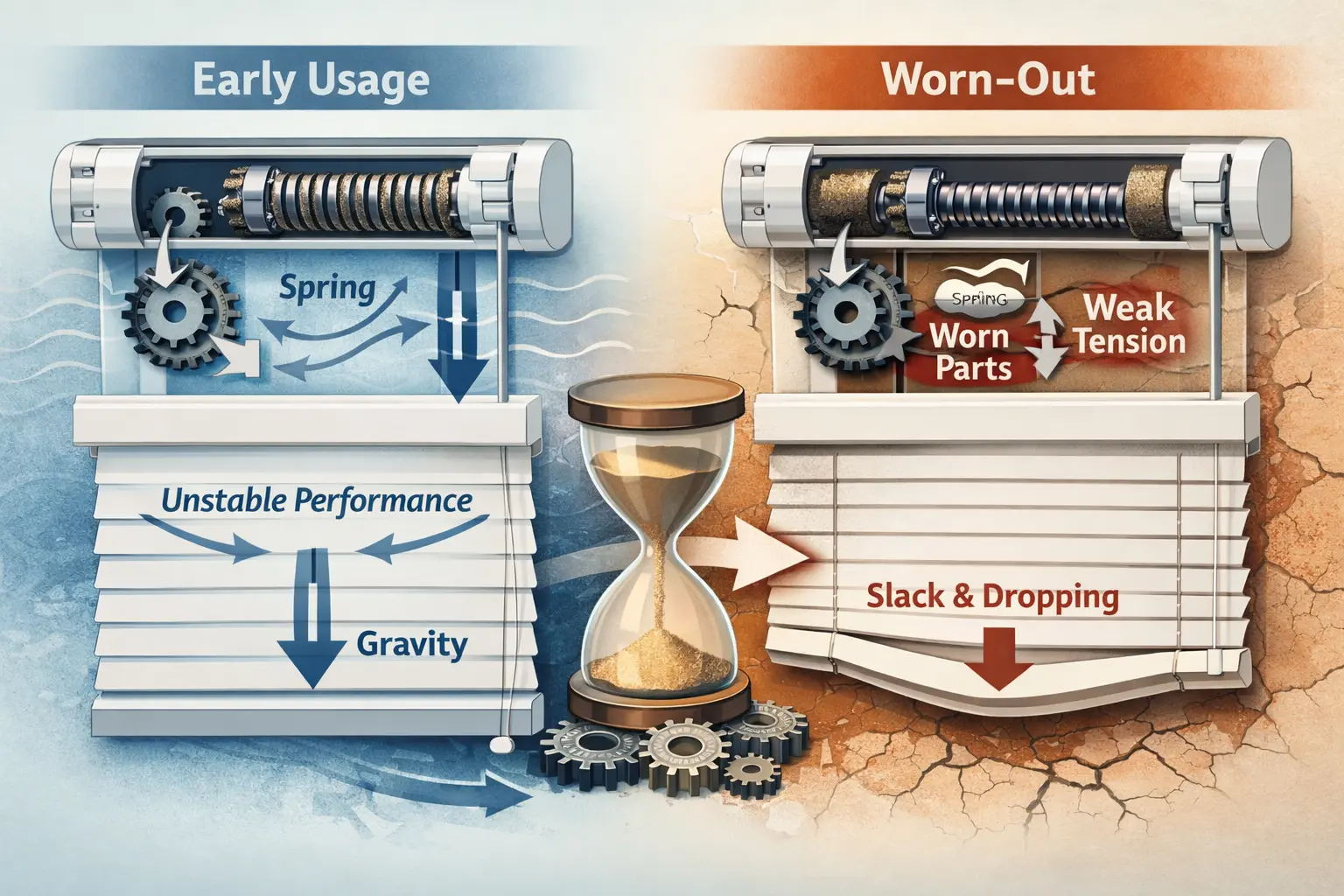
In late-life failures, performance collapses because parts are worn.
In early-life failures, performance collapses because the system hasn’t settled into a repeatable state yet.
That’s why the first 0–1,000 cycles are brutal: the platform is still changing—slightly, quietly, but enough to matter.
Think of it as a mechanical system “warming up,” except the warm-up can expose weak margins immediately.
The Three Stabilization Mechanisms That Drive 0–1,000 Cycle Failures
1) Spring Preload Release: Your “Day-1 Torque” Is Not Your “Day-30 Torque”
Many spring-driven cordless designs rely on initial preload to land inside a target force band.
But preload is not a permanent promise—early cycles can release or redistribute preload due to:
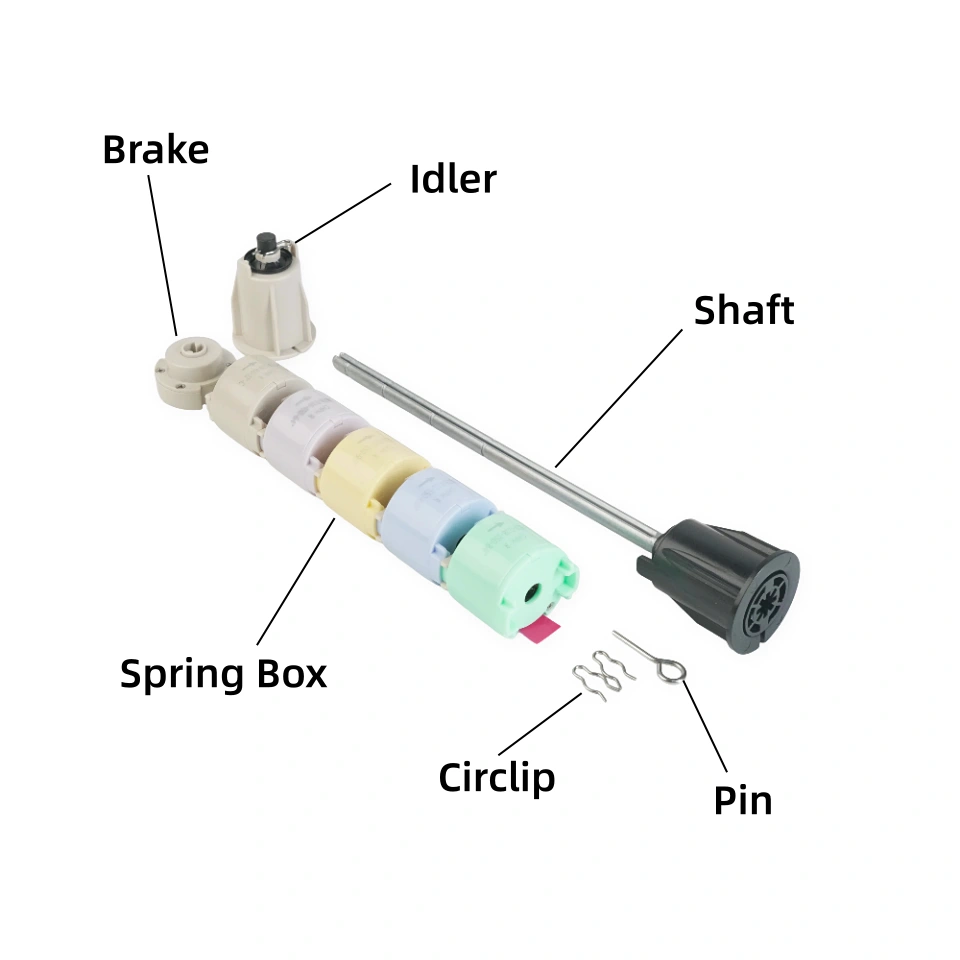
- Micro-settlement at attachment points (hook seats, shafts, pins, circlips).
- Spring pack relaxation (small changes in coil/strip seating and contact points).
- Assembly tolerance “stacking” becoming real motion under repeated cycling.
Result: the system may feel perfect during factory pull tests, then drift or rebound at the customer site
after a few hundred cycles—because the preload “moved.”
2) Friction Interface Run-In: The Friction You Designed Is Not the Friction You Shipped
Early cycles are when friction interfaces establish their real contact pattern.
This is not optional. It happens in every system with sliding or braking interfaces.
- Surface asperities flatten and wear-in, changing effective friction.
- Lubrication migration (or depletion) shifts friction zones across travel.
- Plastic creep / seating in polymer interfaces can slightly change clamping pressure.
If your brake depends on a narrow friction window, “run-in” can move it out of spec fast:
you’ll see stick-slip, chatter bands, or hold instability even when “lift” still feels smooth.
3) Force Band Has Not Converged Yet: The System’s Operating Window Is Still Moving
In a healthy platform, the force band (the stable range where the brake can govern motion and hold position)
becomes repeatable across units, across travel, and after cycling.
In the first 0–1,000 cycles, that band is often still “floating” because spring output and friction authority are both evolving.
What Early-Cycle Failure Looks Like (Symptoms → Root Mechanism)
| Early Symptom (0–1,000 cycles) | Most Likely Mechanism | Why It Shows Up Early |
|---|---|---|
| Shade holds at mid-height, but drifts near top/bottom | Force band not converged + geometry extremes | Extremes amplify small changes in friction and effective radius |
| “Smooth lift” but poor holding / micro-creep | Brake authority mismatch | Lift is transient; hold needs continuous equilibrium |
| New noise after a few hundred cycles | Run-in friction → stick-slip / chatter band | Contact patch stabilizes; friction curve changes |
| Unit-to-unit inconsistency suddenly becomes visible | Tolerance stack becomes dynamic | Repeated cycling turns “static offsets” into real motion paths |
| Rebound after release (overshoot) | Preload redistribution + low damping margin | Early seating shifts spring output faster than the brake adapts |
Why Early-Cycle Failures Hurt OEMs More Than Late-Cycle Failures
Late failures are often scattered and slow.
Early failures are different: they appear fast, cluster by batch, and spread by reviews.
Worst part? They frequently slip through validation because many test plans look like:
“Does it lift smoothly out of the box?” (Yes) → “Ship it.” (Oops)
If you’re building an OEM private-label platform, early-cycle stability is where your margin lives.
It’s the difference between a “nice showroom sample” and a reliable production platform.
How to Test for the 0–1,000 Cycle Stabilization Phase
You don’t need exotic equipment—you need the right sequence.
The goal is to measure whether the system’s force band converges, and stays governable.
- Run-in first: cycle the unit to 200–500 cycles before “official” measurement.
- Measure across full travel: top, mid, bottom (not just mid-height feel).
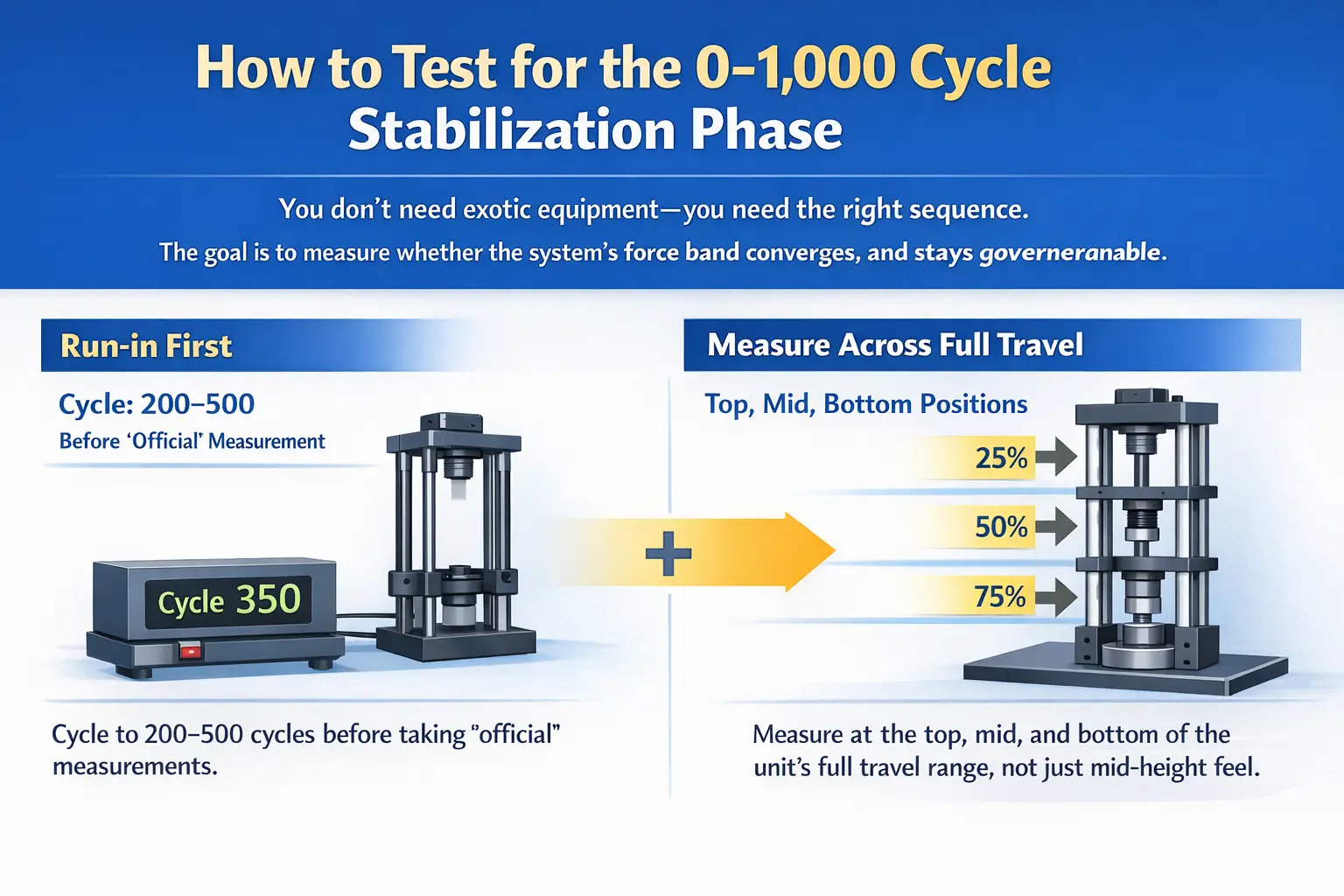
- Track holding drift at multiple heights (e.g., 25%, 50%, 75% travel).
- Repeatability check: compare unit-to-unit variance after run-in, not before.
- Listen for chatter: noise is often the earliest signal of friction-band instability.
FAQ: Early-Cycle Failures (0–1,000 Cycles)
Q1: If failures happen early, doesn’t that prove the material is bad?
Not necessarily. Early failures often indicate stabilization margin is too small:
preload shifts, friction runs in, and the force band moves out of the governable window.
Q2: Why do some units fail early while others don’t?
Because early-cycle behavior is where tolerance stacking becomes visible.
Small differences in assembly, surface finish, or interface seating can move the system across the stability boundary.
Q3: Can a stronger brake solve early-cycle drift?
Sometimes it masks drift short-term, but it can also increase pull force and create stick-slip.
The more robust fix is making the force band stable, then matching brake authority to that band.
Q4: Why do early issues appear near the top or bottom travel?
Geometry and friction are rarely uniform across travel.
Extremes expose weak zones first—where effective radius changes, friction gradients grow, and the band is least forgiving.
Q5: What’s the simplest “quick screen” for early-cycle risk?
Run 300–500 cycles, then check holding drift at multiple heights.
If hold stability changes materially after run-in, your platform is not converging—yet.
Q6: Do wider blinds fail earlier for the same reasons?
Yes—and faster. Width increases lever-arm effects, amplifies left–right mismatch,
and reduces self-correction. Early-cycle instability becomes visible tilt and drift sooner.
Q7: Is “smooth hand feel” a reliable early-cycle indicator?
No. Smoothness can come from low friction today.
Early-cycle reliability depends on whether spring output and braking authority remain matched after run-in.
Field Insight
If your first 1,000 cycles look “fine,” you might still be in danger—because many platforms only reveal instability
after preload release and friction run-in shift the force band.
- Early-cycle failures ≠ aging. They are a stabilization problem.
- Preload moves, friction evolves, and the force band converges—or it doesn’t.
- Validate the platform after run-in, across full travel, and across unit variation.
- If you want fewer returns, design for stability margins, not just showroom smoothness.