Spring vs. Motorized: Which System Offers Better ROI for Manufacturers?
Quick Summary
For blind manufacturers, the real ROI of a lift system is not only the hardware price. It is the
total cost of ownership: tooling, assembly time, installer learning curve, call-back rate and the
price premium the market will accept over basic chain-operated products.
This article compares cordless spring-lift systems and motorized blind systems from a
manufacturer’s point of view. Instead of asking “Which is absolutely better?”, we ask a sharper question:
“In which product segments does each system deliver the strongest ROI?”
You will find a practical three-dimension framework (Cost, Risk, Value), sample ROI tables, and a roadmap to
build a mixed spring + motor portfolio without doubling your engineering workload.
1. Why ROI Decisions Are No Longer Only About BOM Cost
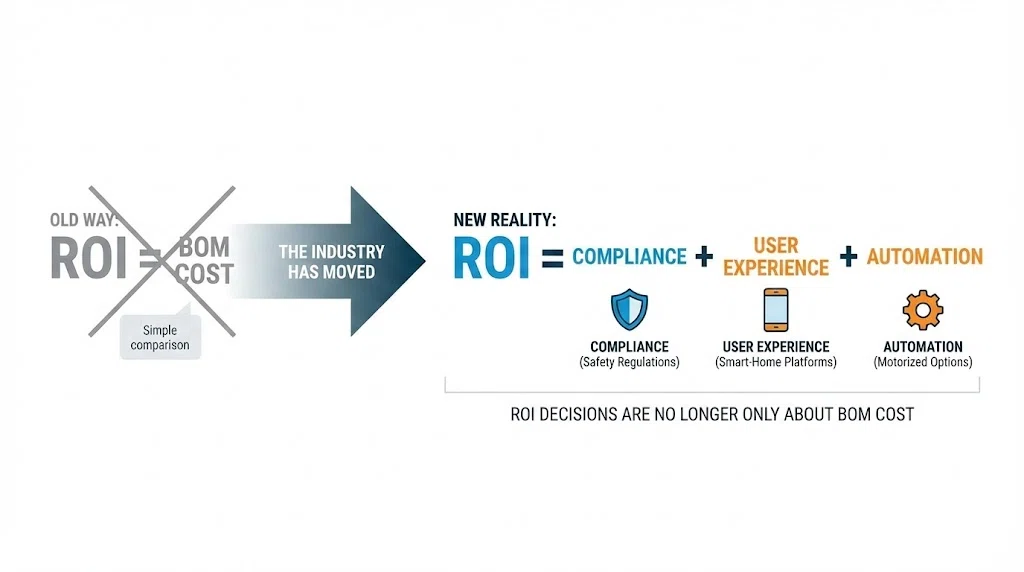
Over the last few years, the blind industry has moved from “hardware price competition” to a mix of
compliance pressure, user-experience expectations and automation demand. Corded systems are being pushed
out by child-safety regulations; at the same time, smart-home platforms are training consumers to expect at
least some motorized options.
For manufacturers, this means that choosing between a spring system and a motorized system is no longer a
simple cost comparison. A platform that looks cheaper on the drawing board can become very expensive after you
factor in:
- Assembly and installation minutes per blind (labor cost and capacity per day).
- Installer errors and call-backs caused by complex setup or poor force matching.
- Warranty claims from noisy operation, drifting positions or electronic failures.
- Channel requirements: some retailers now demand cordless as a minimum, and motors for key ranges.
- Price premium and upsell potential vs basic chain-driven blinds.
In other words, ROI sits at the intersection of Cost, Risk and Value – and spring vs. motor performs
differently on each axis. :contentReference[oaicite:0]{index=0}
2. What Exactly Are We Comparing?
To avoid apples-to-oranges confusion, let’s define the two system families at a component level.
2.1 Cordless Spring-Lift Systems (Spring Platform)
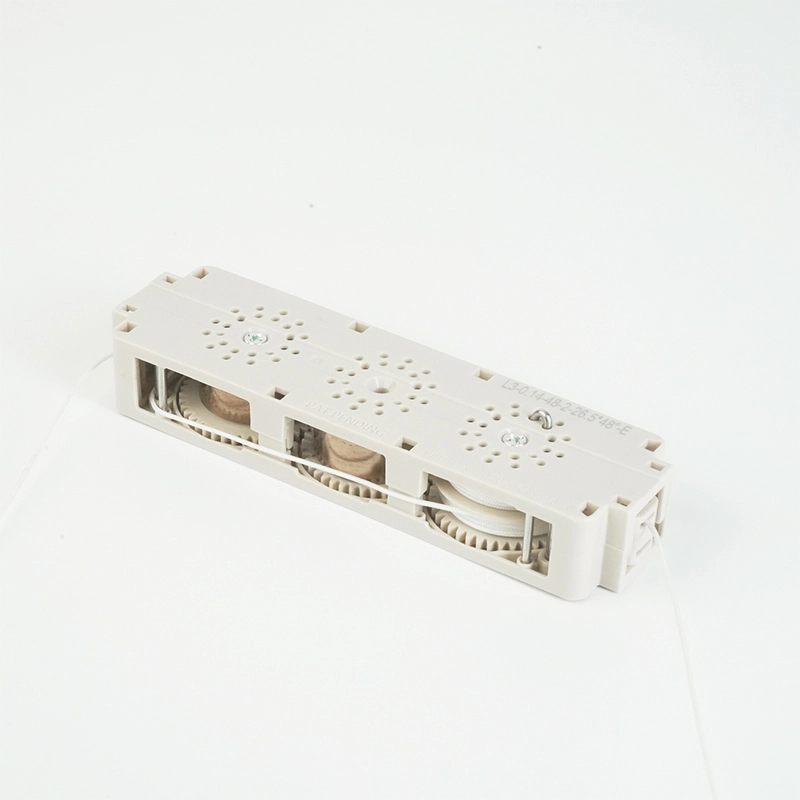
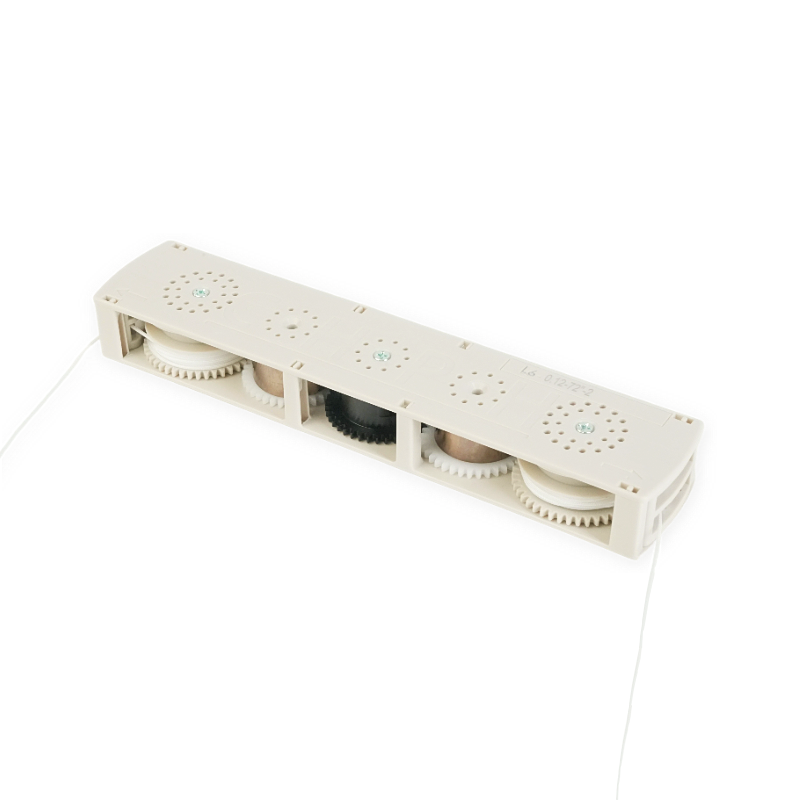
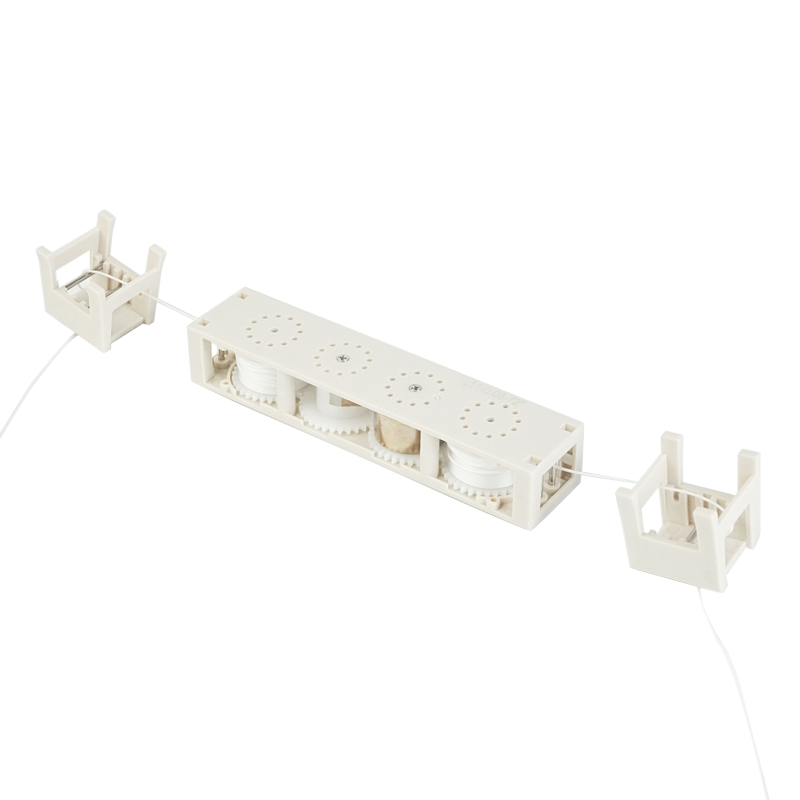
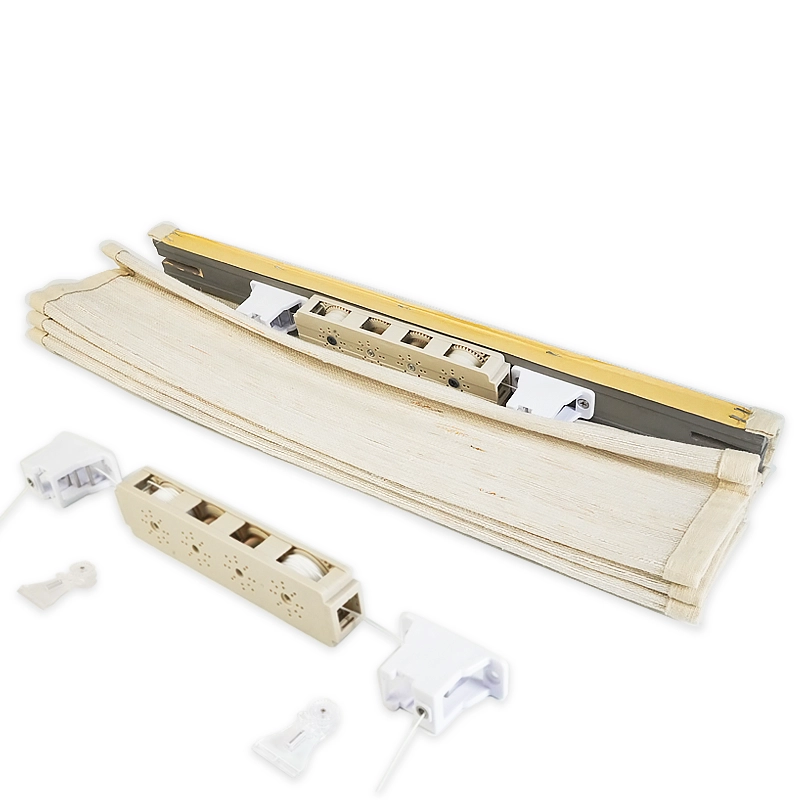
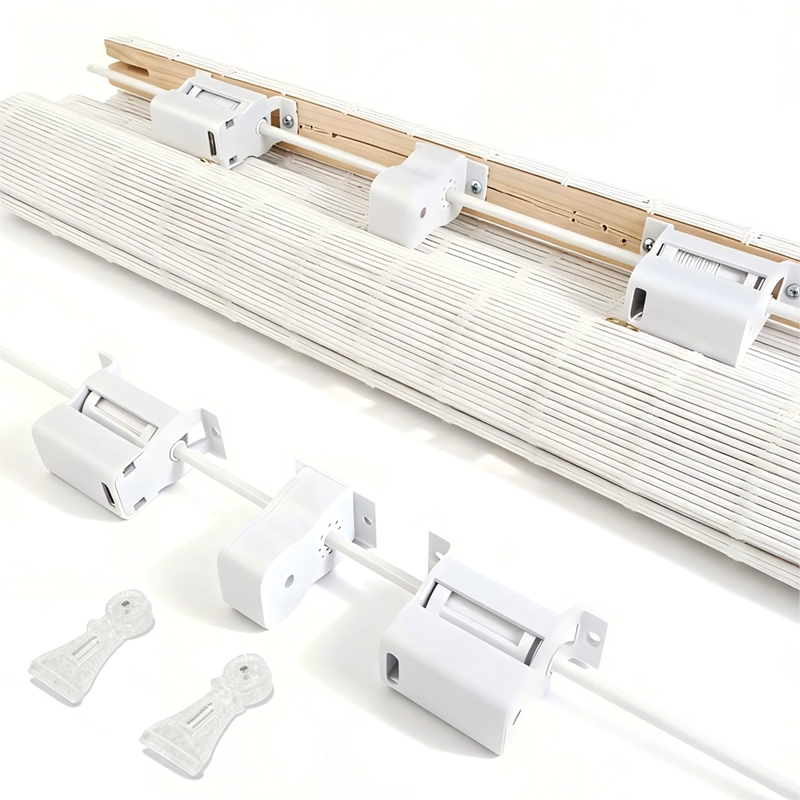
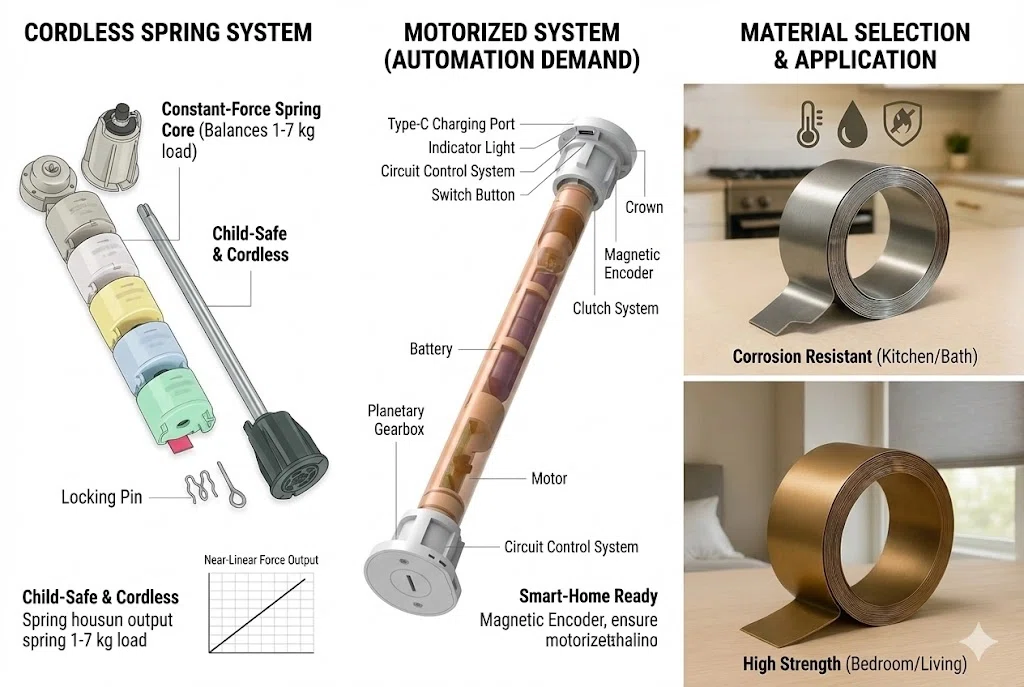
A modern cordless spring system for roller or zebra blinds is built around a constant-force spring core
housed in a POM or metal box, working with a brake and guide components to balance the blind’s weight.
Properly designed, this platform:
- Uses spiral torsion / constant-force springs sized for tube diameters like Ø25 / Ø28 / Ø32 / Ø38 mm.
- Balances typical loads from ~1–7 kg of fabric and bottom rail. :contentReference[oaicite:1]{index=1}
- Provides near-linear force output over the full stroke, so the blind can stop at any height.
- Operates with quiet, low-friction movement when force and damping are matched correctly.
- Is fully cordless, meeting child-safety requirements without external chains.
For manufacturers, the main investment is in spring families, load charts, and standardized headrail/tube
interfaces.
2.2 Motorized Blind Systems (Motor Platform)
A motorized blind system typically uses a tubular motor or a slim motor module driving the same aluminum
tube family, with options for:
- Low-voltage battery motors (built-in lithium cells, USB or solar charging).
- DC powered motors with plug-in adapters for residential projects.
- AC motors integrated to building management systems for commercial projects.
- Control via remote, wall switch, app, voice or gateway (Wi-Fi, Zigbee, etc.).
Here the main investments are in electronics, firmware, certifications, pairing logic, and after-sales
support for installers and end users.
3. ROI Dimension #1 – Up-Front Investment & SKU Strategy
A cordless spring system is usually cheaper per unit than a full motor, but ROI depends on how it behaves across
your SKU range and assembly line.
3.1 Typical Cost & Complexity Comparison
| Lift System Type | Typical BOM Cost vs. Chain System* | Assembly & Setup Time per Blind | Installer Skill Requirement | SKU Complexity |
|---|---|---|---|---|
| Cordless spring-lift only | +20–40 % | ~5–8 minutes | Low–medium (mechanical focus) | Moderate (spring models per load window) |
| Motorized only (battery tubular) | +80–150 % | ~8–15 minutes (mounting + pairing) | Medium–high (electrical + app) | High (motor models, power, controls) |
| Hybrid spring + motor platform | +60–120 % | ~8–12 minutes | Medium | Optimized (shared tubes, brackets, rails) |
*Illustrative ranges vs. a basic chain-operated roller blind using the same fabric, tube and hardware level.
The pattern is simple:
springs win on BOM and simplicity, motors win on ticket size and smart-home compatibility.
3.2 Where Springs Shine Financially
- High-volume standard sizes where consumers mainly want cordless safety and quiet operation.
- DIY and retail channels, where simple installation matters more than advanced automation.
- Projects with thousands of openings but limited automation budget – e.g. education, mid-range hospitality.
3.3 Where Motors Justify the Extra Cost
- Premium residential and luxury apartments where “press a button” is expected.
- Hard-to-reach windows (stairwells, tall atriums) where manual control is inconvenient or unsafe.
- Smart-home integrators and BMS projects where the blind is part of an energy and comfort strategy.
4. ROI Dimension #2 – User Experience, Noise & Call-Back Risk
Whether you use springs or motors, the fastest way to destroy ROI is to ship a product that annoys the user:
noisy lifting, drifting positions, or controls that are hard to understand.
4.1 Spring Systems: ROI Depends on Force Matching
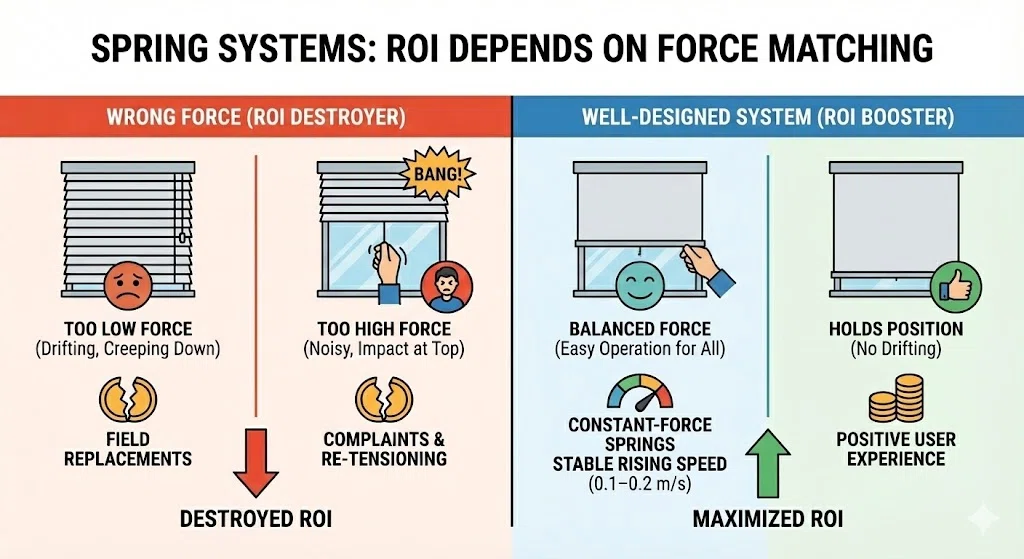
A well-designed spring system with constant-force springs can keep pull forces around
≤ 30 N and maintain a stable rising speed of about 0.1–0.2 m/s.
In practice, this means:
- Children and elderly users can operate the blind easily.
- The bottom rail does not “shoot” to the top and bang the headrail.
- The blind holds position without creeping down.
When spring selection is wrong (force too low or too high), manufacturers see:
- Complaints about heaviness on large blackout blinds.
- Noise and impact when the blind reaches the top too quickly.
- Field re-tensioning or complete unit replacements – both eating ROI.
4.2 Motorized Systems: Electronic Convenience, New Failure Modes
Motorized blinds reduce the risk of “heavy feel” and give a very consistent motion profile, but they introduce
new risk points:
- Pairing and programming mistakes by installers and end users.
- Battery complaints (“motor is dead”, “blind stopped mid-way”).
- Compatibility questions with hubs, apps and voice assistants.
In markets where installers are not yet very familiar with blinds motors, these issues can generate higher
call-back rates than a mature spring platform. The ROI question becomes:
can your organization support the electronics and software learning curve?
5. ROI Dimension #3 – Market Value, Pricing Power & Differentiation
Once safety and basic quality are covered, ROI is driven by the price premium you can achieve and how
“future-proof” the product feels to buyers.
5.1 How Much More Will the Market Pay?
| Segment | Recommended Core System | Typical Selling Price Premium vs. Chain | Main Value Story |
|---|---|---|---|
| Mass retail (DIY) | Cordless spring-lift | +20–50 % | Child safety, cleaner look, quiet operation. |
| Mid-market residential projects | Spring as standard, motor as upgrade | +40–80 % (spring) / +120–200 % (motor) | Cordless comfort as base, “push-button luxury” for key rooms. |
| High-end residential & smart homes | Motorized (battery / DC) | +150–300 % | Smart integration, schedules, voice control, energy savings. |
| Commercial & office buildings | Motorized (DC / AC) | Project-specific | Central control, façade management, daylight & glare control. |
In many portfolios the best ROI mix is:
spring systems as the default cordless solution for 60–80 % of SKUs, and
motorized SKUs as high-margin upgrades and for special applications.
6. When Does a Spring System Deliver Better ROI?
A cordless spring platform is often the better ROI choice when you:
- Operate in markets where child-safe cordless is mandatory, but smart-home penetration is still low.
- Sell through DIY chains or mid-tier dealers who want simple installation and limited electronics.
- Need to update existing corded ranges quickly without redesigning every headrail and bracket.
- Want to reduce field risk from cords and chains while keeping hardware cost under tight control.
Properly engineered spring systems also give you a story beyond “compliance”:
smooth, quiet operation and a premium tactile feel that users immediately notice.
7. When Does Motorization Deliver Better ROI?
Motorization often wins the ROI game when your strategy is to:
- Position your brand as smart-home ready or tech-driven.
- Work with integrators and developers who already sell lighting, HVAC and security controls.
- Target large commercial projects with energy and comfort management goals.
- Capture recurring revenue from accessories, gateways and service contracts.
In these spaces, the question is not “spring vs. motor” but:
“Which motor platform, and how do we make it share as much hardware as possible with our manual blinds?”
8. Building a Mixed Portfolio Without Doubling Engineering Work
The most profitable manufacturers treat spring and motor as two faces of one platform, not as separate
product universes. A practical roadmap:
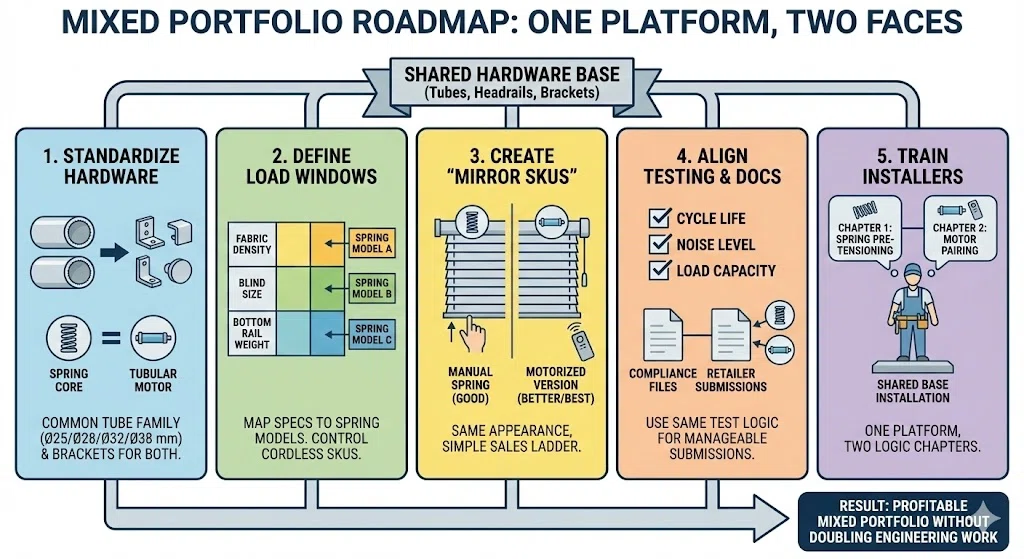
- Standardize tubes and headrails.
Choose a tube family (e.g. Ø25 / Ø28 / Ø32 / Ø38 mm) that works for both spring cores and tubular motors,
with common brackets and end caps where possible. - Define clear load windows for each spring family.
Use engineering tools to map fabric density, blind size and bottom rail weight to spring box models. This
keeps your cordless SKUs under control and reduces mis-selection risk. :contentReference[oaicite:3]{index=3} - Create “mirror SKUs”.
For key widths and heights, define a manual spring version and a motorized version with the same appearance,
so sales teams can offer a simple “good / better / best” ladder. - Align testing and documentation.
Use the same test logic (cycle life, noise, load) for spring and motor versions, so compliance files and
retailer submissions stay manageable. - Train installers on one platform, two logics.
Mechanically, installation remains similar (same brackets, same tubes). Installers only need to learn spring
pre-tensioning and motor pairing as two separate “chapters” on top of a shared hardware base.
FAQ: Spring vs. Motorized ROI for Blind Manufacturers
1. Is a cordless spring system always cheaper than a motor?
On pure BOM cost, yes – a spring core is usually significantly cheaper than a battery tubular motor. However,
ROI depends on the selling price and after-sales cost. In a segment where end users will happily pay for
automation and your team can support it, a motorized blind can deliver a higher gross margin per opening despite
its higher cost.
2. How many spring models do we really need?
A common strategy is to design 3–5 spring models that cover clear load windows (e.g. “small”, “medium”,
“heavy” blinds). With good load charts and selection tools, this can cover the majority of roller and zebra blind
SKUs without creating a jungle of part numbers.
3. What is the biggest hidden cost of motorization?
For many manufacturers, the largest hidden cost is not the motor itself, but support and education:
installer training, end-user questions about pairing and apps, and handling battery-related complaints. If you
price motorized products only with a hardware margin mindset, you may underestimate these overheads.
4. Should we design hybrid spring + motor rollers?
A hybrid roller, where the spring shares the load with the motor, can reduce motor torque requirements and
improve quietness. This approach makes sense if you aim for slim, battery-powered motors on larger blinds,
or if you want a consistent “feel” between manual and motorized ranges. It does require careful engineering and
testing, but it can be a strong differentiator.
5. How do we explain the difference to non-technical buyers?
For marketing and sales teams, keep the story simple:
- Spring-lift = cordless safety + quiet + great feel at a reachable price.
- Motorized = touch-free comfort + smart control where convenience and status matter more.
Internally, you manage complexity with engineering, load charts and platform thinking; externally, you sell
clear experiences.
Field Insight
In today’s market, the question is rarely “Spring or motor – which one wins forever?” The most resilient
manufacturers use springs to protect volume and margins in mainstream cordless blinds, and
motors to unlock premium price points and project opportunities. If your platform lets both systems share
tubes, brackets and test logic, you turn what looks like a product choice into a portfolio-level ROI strategy.