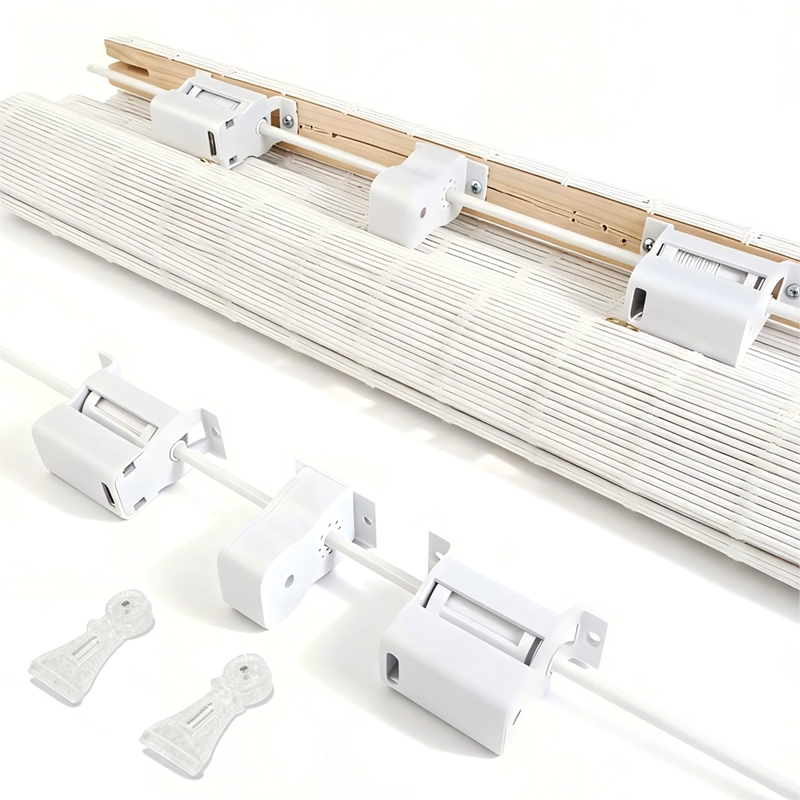
Why reliable cordless systems are not built from “good parts”,
but from governed force relationships.
From Components to Predictability
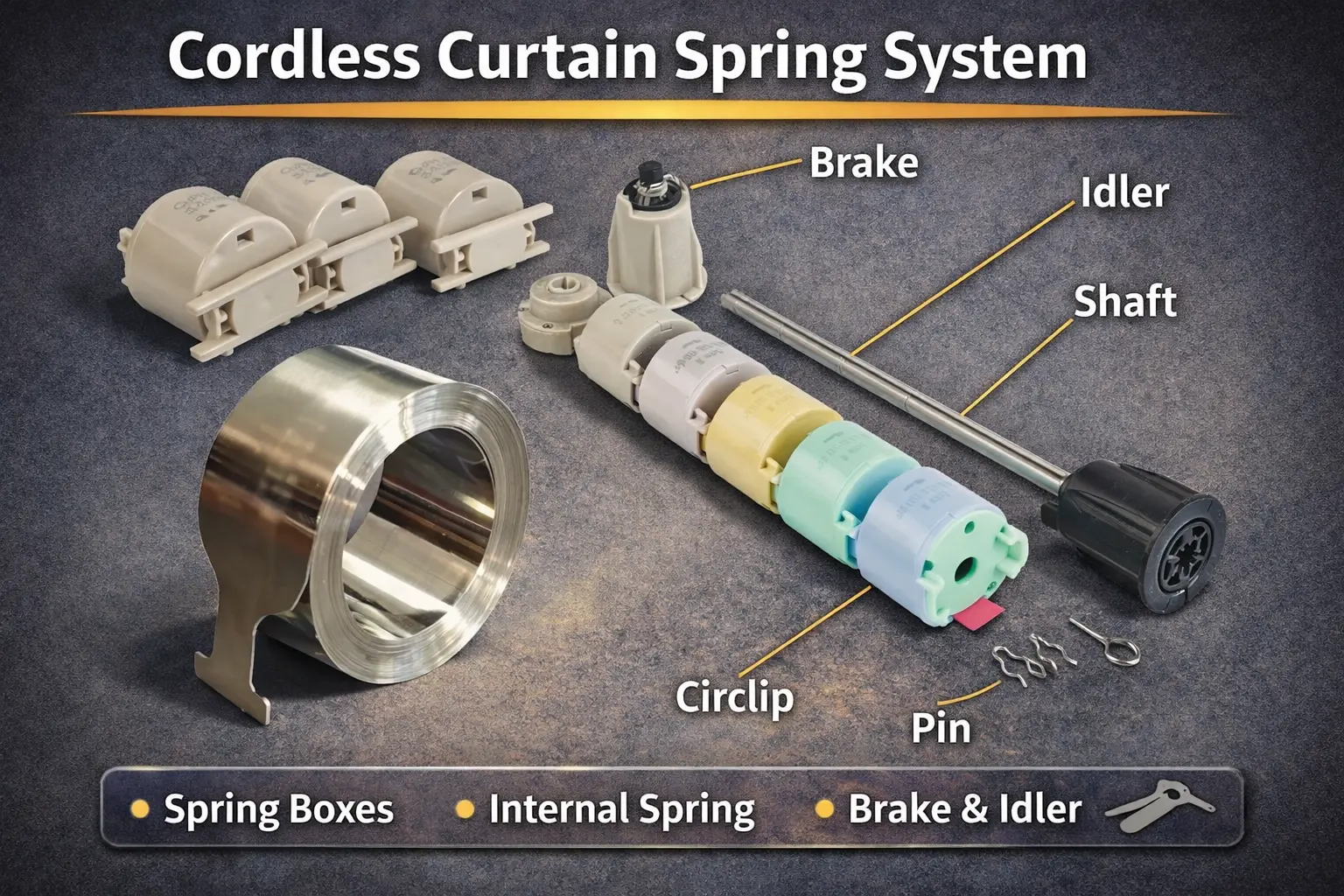
Quick Summary
Most cordless blind failures are not caused by a single weak component.
They happen because independent parts never converge into a predictable force system.
This article explains how to move from component-level thinking
to system-level predictability—using measurable force bands,
stabilization windows, and material-governed braking behavior.
1. Components Don’t Fail — Systems Do
A spring can meet spec.
A brake can pass inspection.
A mold can be dimensionally perfect.
And the system can still drift, chatter, or collapse after installation.
This is the same failure pattern discussed in
Why Cordless Blinds Are Force-Balance Systems, Not Fabric Products:
performance lives in interaction, not in isolation.
| Element | Typical Pass Condition | What It Does NOT Guarantee | System Risk |
|---|---|---|---|
| Spring Box | Rated torque @ room temp | Full-travel force stability | Top / bottom sluggish zone |
| Brake | Static hold force | Dynamic stick-slip control | Chatter, noise spikes |
| Mold Geometry | Dimensional tolerance | Material behavior over cycles | Early drift misdiagnosed |
2. Predictability Starts with a Converged Force Band
A cordless system becomes predictable only when
its usable force band converges before braking authority is applied.
This is why early-cycle failures dominate the first 0–1,000 cycles,
as explained in
why-most-cordless-shade-systems-fail-early-a-lifecycle-engineering-perspective
| Metric | Target Range | Observed if Unstable |
|---|---|---|
| Force variation over travel | ≤ ±5% | Mid-travel feels smooth, ends fail |
| 0–500 cycle drift | ≤ 3%</ change | Progressive drop or rebound |
| Hold stability | 0 mm creep @ 60 s | Slow downward migration |
If the force band is still spreading or shifting,
no brake can make the system predictable.
3. Brakes Govern Motion — Materials Govern Behavior
Once the force band is stable,
the brake’s job is not to “fix” imbalance,
but to govern motion within that band.
As detailed in
Braking Is a Material Science Problem, Not a Mold Problem,material behavior dominates after geometry is fixed.
| Brake Material | Temp Sensitivity | Cycle Sensitivity | Typical Noise Outcome |
|---|---|---|---|
| Standard PA | High | High | 40–55 dB chatter spikes |
| Filled POM | Medium | Medium | Occasional stick-slip |
| Engineered resin blend | Low | Low | ≤ 35 dB stable glide |
If performance shifts mainly with temperature or cycles,
you are seeing material friction drift, not mold error.
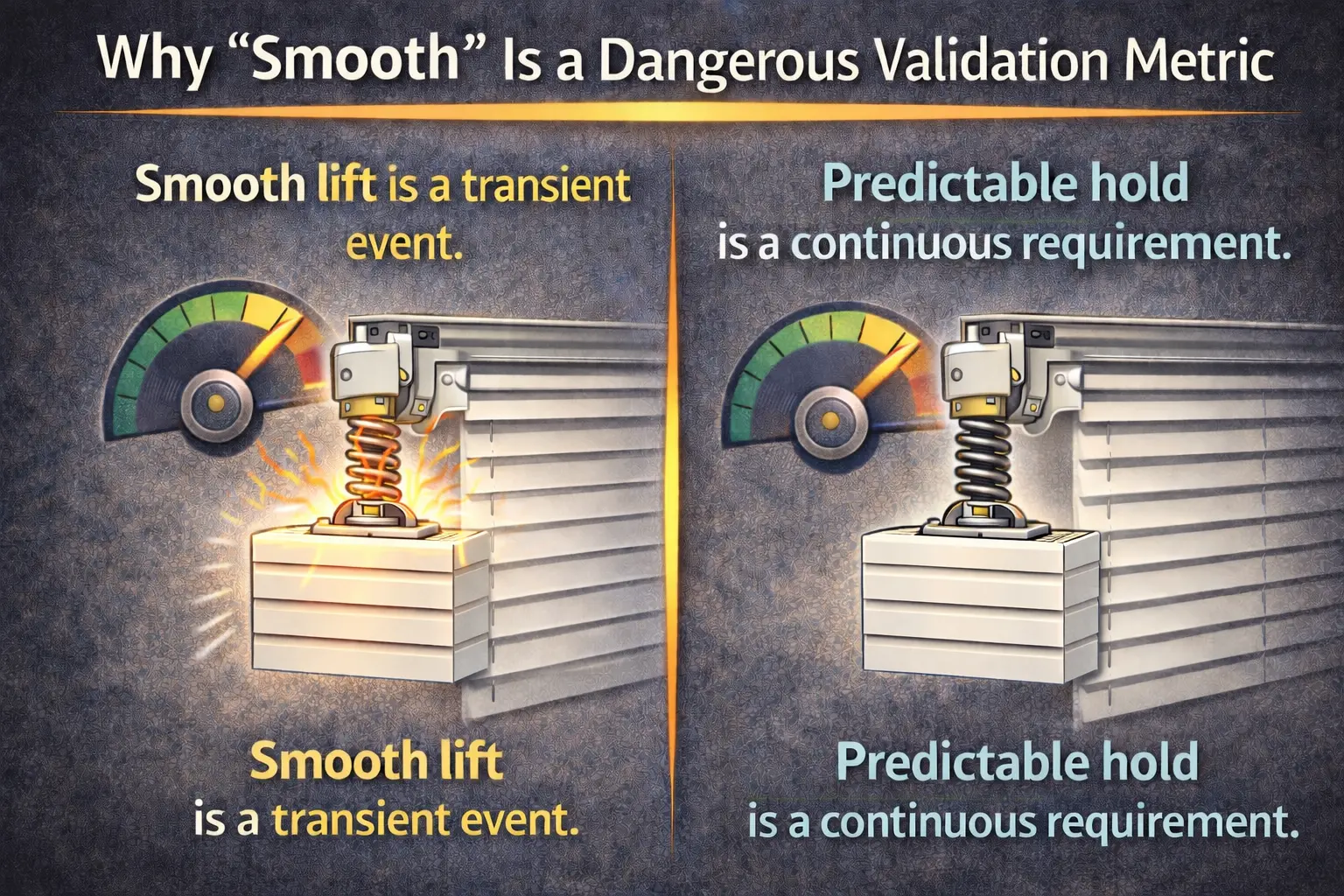
4. Why “Smooth” Is a Dangerous Validation Metric
Smooth lift is a transient event.
Predictable hold is a continuous requirement.
This distinction was explored in
Spring Systems Are Not Static — Fabric Weight Changes Everything.
| Test Point | What It Measures | What It Misses |
|---|---|---|
| Mid-travel hand feel | Peak smoothness | Force edge collapse |
| Short-stroke cycling | Initial comfort | Stabilization behavior |
| Full-travel + aging | System predictability | — |
If you don’t test the extremes,
you are validating comfort—not reliability.
5. Predictability Is an Engineered Outcome
Predictable systems are designed, not discovered.
They emerge when force, friction, and braking authority
are engineered as a single closed loop.
| Design Layer | Control Variable | Predictability Impact |
|---|---|---|
| Spring | Torque curve convergence | Defines usable force window |
| Interfaces | Friction stability | Prevents drift & chatter |
| Brake | Damping authority | Controls motion, not balance |
Engineering FAQ
Q1: Can stronger braking compensate for unstable springs?
Only temporarily. Increased friction may stop drift in the short term,
but it raises pull force and significantly increases stick-slip risk.
Long-term predictability requires force-band stability first, not friction escalation.
Q2: Why do many failures appear weeks after installation?
Because the system finally reaches its full force envelope after run-in.
Material bedding, surface polishing, and preload release expose weak stability margins
that were invisible during initial showroom testing.
Q3: What is the minimum test window for predictability?
Full travel testing with top / mid / bottom checkpoints,
plus at least 500–1,000 conditioning cycles.
Mid-travel-only or short-stroke testing cannot reveal edge-zone instability.
Q4: Why does a system feel smooth but still fail to hold position?
Because lift smoothness is a transient condition,
while hold stability is a continuous equilibrium problem.
A system can feel smooth during motion yet lack the force balance required to resist gravity over time.
Q5: Why do top and bottom zones fail more often than mid-travel?
Because torque demand and friction dominance shift at travel extremes.
These zones expose force-band misalignment, geometric leverage changes,
and material friction limits that mid-travel testing masks.
Q6: Is early drift a sign of poor material quality or bad design?
Usually design margin, not material quality.
Early drift often means the usable force band never fully converged,
leaving braking to compensate for imbalance rather than govern motion.
Q7: Can mold precision alone guarantee system stability?
No. Mold precision defines geometry, not behavior.
Once geometry is fixed, performance variation is dominated by
material friction, thermal response, and cycle-dependent surface evolution.
Q8: Why does increasing preload sometimes make systems worse?
Because excessive preload narrows the usable force window.
It can increase pull force, amplify stick-slip,
and reduce tolerance to material or temperature variation across the lifecycle.
Q9: How can you distinguish material friction drift from alignment issues?
Hold geometry constant and vary temperature and cycle count.
If behavior shifts mainly with heat or cycles, it’s material-driven.
If variation appears unit-to-unit under identical conditions, alignment or tolerance is likely dominating.
Q10: When can a cordless system be considered truly predictable?
Only when force output remains governable across full travel,
after stabilization cycles, and under expected temperature conditions.
Predictability is proven by repeatability over time—not by initial feel.
Field Insight
Predictability is not about using better components.
It is about forcing components to agree.
When force bands converge first,
braking becomes governance—not damage control.