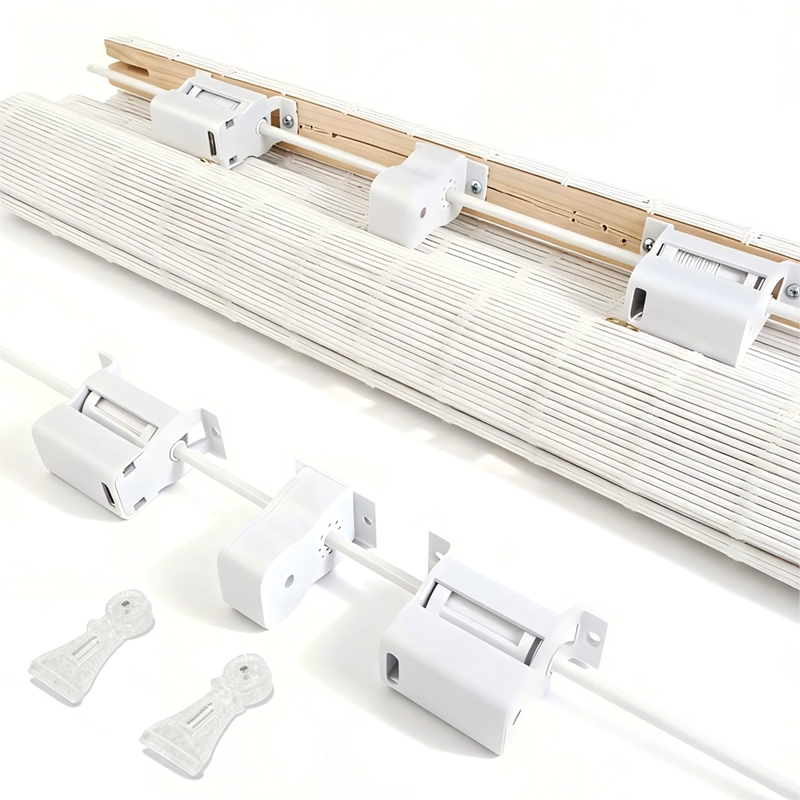
Beyond Compliance: Why the Lift System Defines Your Blind’s Premium Feel

Quick Summary
For today’s buyers, compliance is the entry ticket, not a unique selling point. What truly separates premium blinds from “good enough” products is the lift system—how the blind feels, sounds and responds every time someone raises or lowers it. A well-engineered cordless lift system with constant-force springs, controlled speed, low noise and stable position turns basic blinds into luxury-feeling products, and directly shapes how customers judge your brand.
1. Compliance Is the Floor, Not the Ceiling
Over the past few years, child-safety regulations such as ANSI/WCMA A100.1-2022, CPSC 16 CFR 1260 and EN 13120 have accelerated the shift from corded to cordless blinds. Many brands have already removed exposed cords and updated labels and packaging.
But in the showroom or on a project site, most consumers and designers do not ask which standard you passed. They do something much simpler:
- They place a hand on the bottom rail,
- They raise and lower the blind once or twice,
- They judge your entire brand by that 2–3 seconds of motion.
If the blind feels heavy, jerky, noisy or fails to stop where it should, the product may still be “compliant”, but it does not feel premium. That difference comes almost entirely from the lift system architecture.
 |
 |
2. The Lift System: The Part of Your Blind Customers Actually Touch
Fabric, cassette design and color palettes are chosen by the eye. The lift system is chosen by the hand and the ear. It is the hidden mechanism that defines:
- Perceived weight – Is the blind easy to lift for a child or elderly person?
- Motion quality – Is the movement smooth or does it jump and bounce?
- Acoustic comfort – Does the blind move quietly enough for bedrooms and nurseries?
- Position control – Does it stay exactly where the user leaves it, or drift a few centimetres?
- Safety perception – Is the blind clearly cordless, with no dangling chains or looped cords?
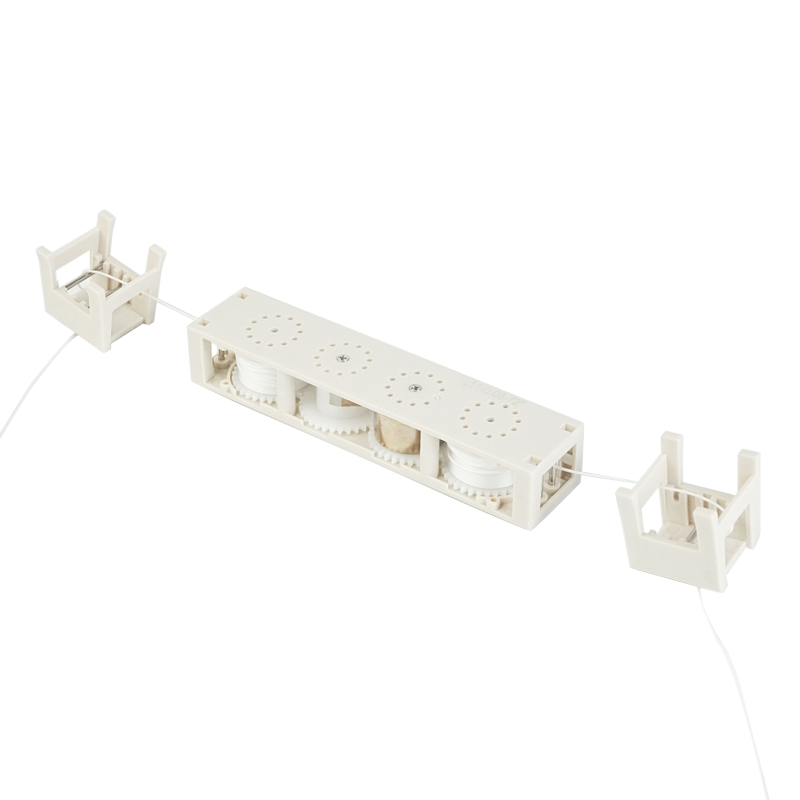
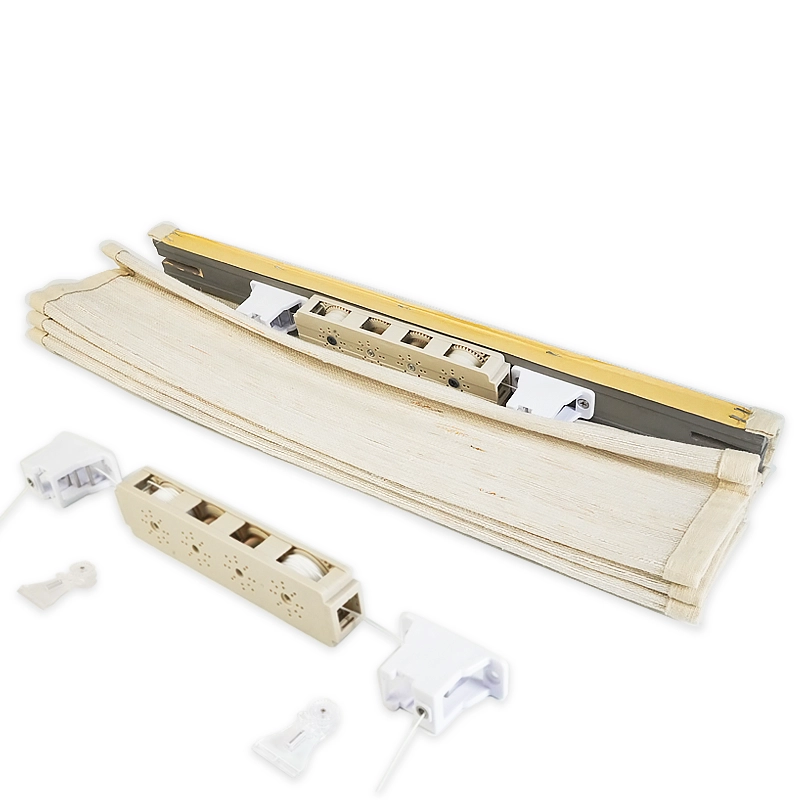
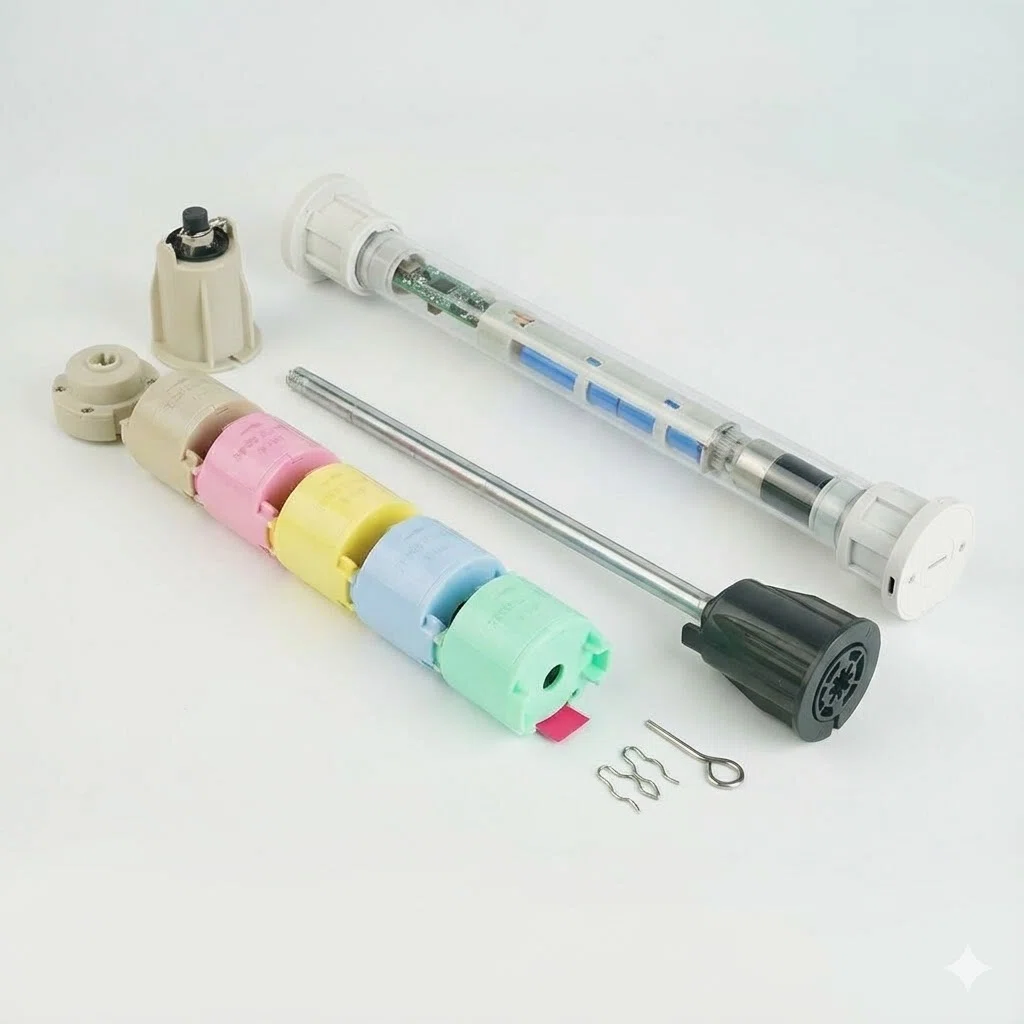
All of these are engineering questions: they depend on spring design, brake and damping strategy, tube and bottom-rail matching, and—where used—how the motor is integrated with the spring.
3. Inside a Premium Cordless Lift System
While designs differ between roller blinds, zebra blinds, honeycomb blinds and faux-wood Venetians, most premium systems share the same core building blocks.
3.1 Constant-Force Spring Core
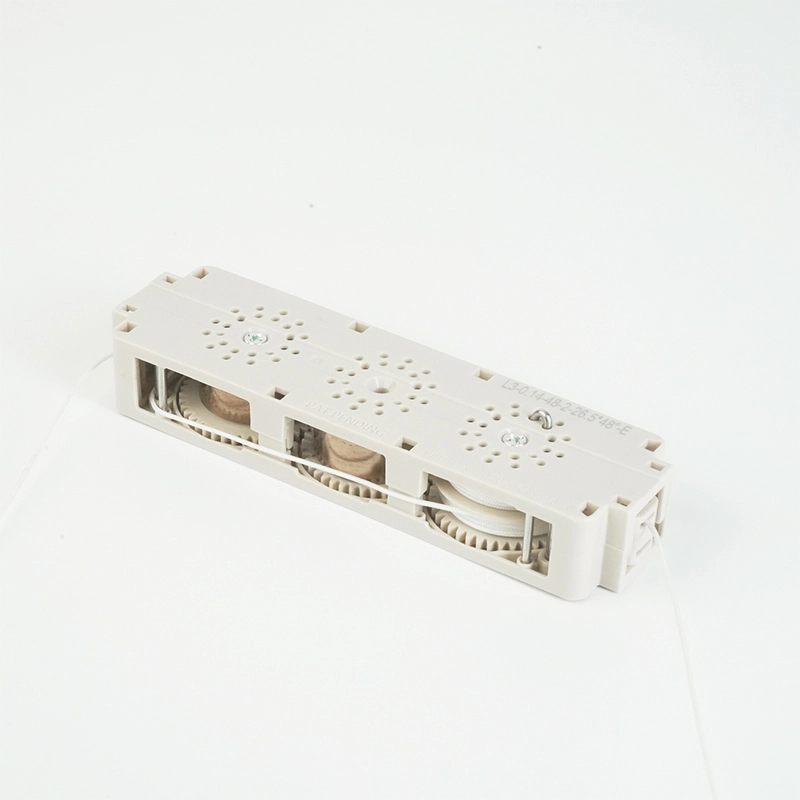
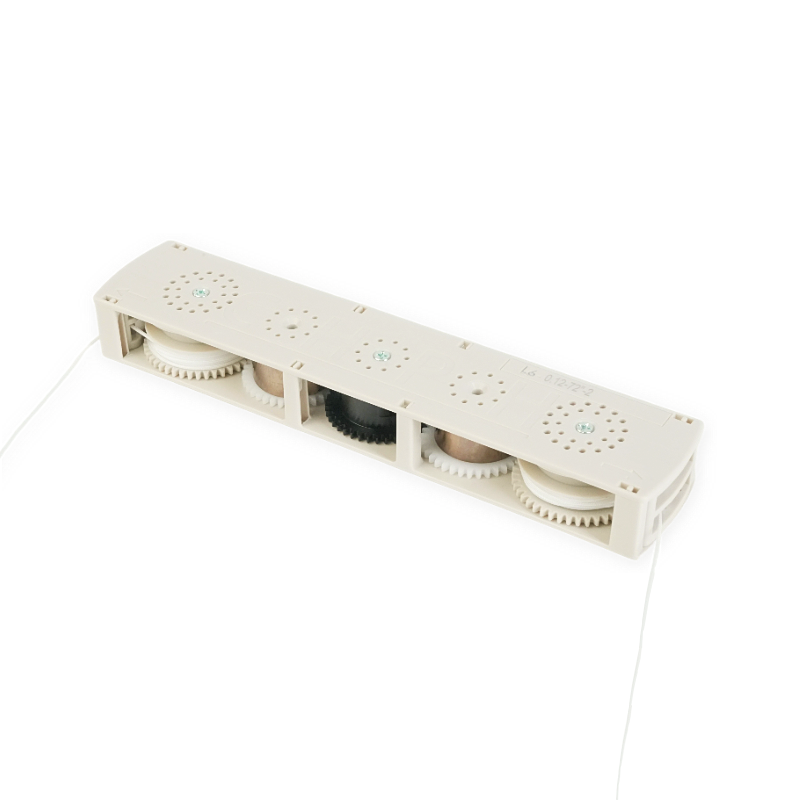
In a premium cordless lift system, the “muscle” is a constant-force spiral spring sealed inside a POM or metal housing. Unlike traditional coil springs, a constant-force design keeps the lifting force almost flat across the full stroke, so the blind feels balanced at any height and does not “snap” at the top or sag at the bottom.:contentReference[oaicite:0]{index=0}
- Material: 65Mn spring steel or 301/304 stainless-steel strip, optimized for elastic limit and fatigue life.
- Typical thickness: 0.2–0.5 mm for residential blinds, tuned to shade weight.
- Design goal: Force fluctuation usually controlled within ±5 % over the stroke for a stable feel.
For the user, this translates to a blind that feels “light but not flimsy” and that can be stopped at any height without effort.
3.2 Brake & Speed Governing
A good spring without control can still feel cheap. If the blind shoots up and bangs into the headrail, the experience is noisy and unsafe.
That is why premium systems pair the spring with a dedicated brake or damping mechanism:
- Speed control: Keep rise speed around 0.10–0.20 m/s, so a full stroke takes roughly 8–15 seconds.
- Impact control: Prevent the bottom rail from hitting the top with a hard “clack”.
- Position control: Hold the blind at any height with minimal drift (<5 mm over time).
The user does not see any of this. They just feel that the blind “follows the hand” and stops exactly where expected.
3.3 Tube, Bottom Rail and Fabric Matching
Even the best spring will feel wrong if it is mismatched to the load. Premium lift systems are always engineered together with:
- Tube diameter (e.g. 25 / 28 / 32 / 38 mm for rollers);
- Fabric density and blind size (width × drop);
- Bottom-rail profile and material (aluminum, steel, plastic).
The target is simple: the user’s pulling force stays within a comfortable window (often 10–30 N), even for large blinds. Outside this range, the blind either feels heavy and tiring, or unstable and “springy”.
3.4 Hybrid Spring + Motor Architectures
In smart homes and higher-end commercial projects, many brands are moving to hybrid lift systems:
- The spring carries a large part of the blind weight.
- The motor provides controlled movement and integration with remotes, apps and building control systems.
This allows:
- Use of smaller motors with lower torque and noise.
- Better battery life because the motor is not lifting the full weight.
- Consistent “feel” between manual cordless blinds and motorized blinds in the same project.
4. Quantifying “Premium Feel”: Engineering Targets You Can Specify
“Premium feel” sounds subjective, but it can be translated into clear engineering targets that you can write into specifications or supplier checklists.
| Parameter | Recommended Target for Premium Cordless Blinds | Why It Matters |
|---|---|---|
| Downward pull force | Approx. 10–30 N over full stroke | Easy for most users, including children and elderly, without feeling flimsy. |
| Rise speed (bottom to top) | 0.10–0.20 m/s (≈ 8–15 s for a typical window) | Slow enough to avoid impact, fast enough not to feel sluggish. |
| Noise level during operation | ≤ 35 dB for bedrooms and nurseries | Supports “quiet home” and “hotel-grade” positioning. |
| Position drift after stopping | ≤ 5 mm over time | Blind stays exactly where the user leaves it. |
| Cycle life | ≥ 10,000–30,000 full cycles (project-dependent) | Guarantees long-term performance with daily use. |
| Force fluctuation over stroke | Within ±5 % | Prevents “heavy at the start, too strong at the end” feeling. |
When these numbers are part of your OEM or project specifications—not just “meets standard X/Y”—you transform the lift system into a differentiator, not a cost item.
5. Beyond Safety: How the Lift System Supports Your Brand Story
A well-designed lift system gives your sales and marketing team something tangible to talk about:
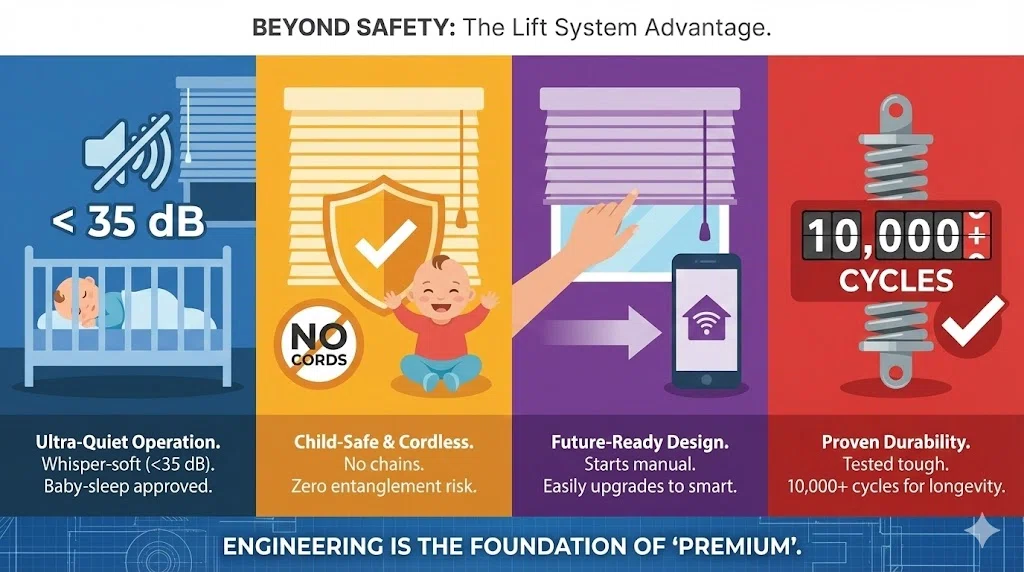
- Quiet lifestyle messaging: “Blinds that move under 35 dB—quiet enough for baby’s nap.”
- Child-safe cordless positioning: “No chains, no dangling cords, no entanglement risk.”
- Smart-home compatibility: “Choose manual cordless now, upgrade to hybrid spring + motor later with the same headrail platform.”
- Durability proof points: “Spring systems tested to 10,000+ cycles for long service life.”
All of this comes back to the lift system design and the data behind it. Without that engineering foundation, “premium” remains just a word in a brochure.
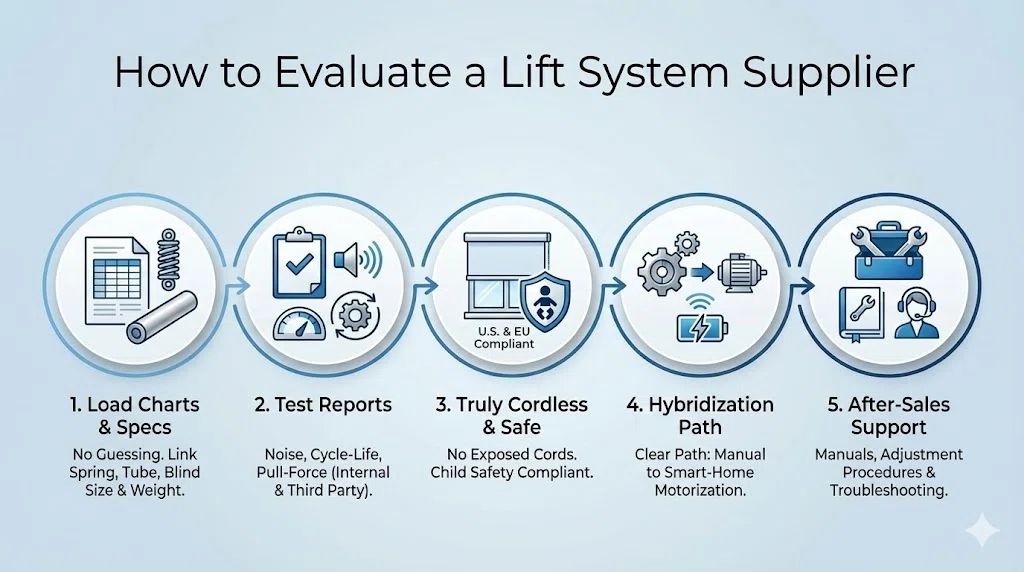
6. How to Evaluate a Lift System Supplier
Whether you are sourcing cordless roller blind systems, zebra blind mechanisms or hybrid spring + motor kits, it pays to ask a few hard questions:
- Can they provide load charts?
Tables linking spring model to tube size, blind dimensions and bottom-rail weight—so your designers are not guessing. - Do they share test reports?
Noise tests, cycle-life tests, and pull-force tests, ideally from internal labs and third parties. - Is the system truly cordless?
No exposed chains or cords on the user side; compliant with current U.S. and EU child-safety expectations. - Can they support hybridization?
For smart-home lines, is there a clear path from manual cordless to spring-assisted motorization? - How is after-sales handled?
Installation manuals, adjustment procedures and troubleshooting guides for field teams.
Suppliers who treat the lift system as a platform—rather than just a single SKU—will make it easier for you to build coherent families of blinds, from entry to luxury level.
7. Practical Steps to Upgrade the “Feel” of Your Blind Range
If you already have cordless collections on the market, improving their premium feel does not always require a full redesign. A simple roadmap:
- Map your existing SKUs
Group blinds by width, drop and fabric weight. Identify where customers most often complain about heaviness, noise or unstable positions. - Align on target user experience
Set clear targets for pull force, noise, speed and cycle life for each segment (nursery, living room, hospitality, office, etc.). - Work with your lift system partner
Adjust spring specifications, pre-tension and damping to match those targets, not just minimum safety requirements. - Run side-by-side tests
Install sample blinds with old and new lift systems in the same frame and let internal teams, installers and key customers compare. - Build the story into your selling tools
Once the mechanism is upgraded, update catalogs, web pages and training to highlight the difference in feel, not only the safety label.
8. FAQ – Lift Systems and Premium Blind Experience
Q1. If my blinds are already child-safe and cordless, why should I still worry about the lift system?
Child-safety compliance removes risk, but it doesn’t guarantee a premium experience. The lift system decides whether customers feel your blinds are quiet, smooth and easy to operate every day. That feeling strongly influences repeat orders and word-of-mouth.
Q2. Are all cordless lift systems basically the same?
No. Some use simple spring mechanisms with large force fluctuation and little damping; others use constant-force springs, tuned pre-tension and well-designed brakes. On the outside they all look “cordless”, but in the hand they feel very different.
Q3. How do I explain the value of a better lift system to my customers?
Focus on outcomes: easier lifting for children and elderly people, quieter operation in bedrooms and nurseries, better blind alignment and longer life. Whenever possible, let customers physically test two blinds side by side—the difference is immediately obvious.
Q4. Is a spring-assisted system still necessary if I use motors?
In many cases, yes. A well-matched spring can share the load with the motor, reducing torque demand, lowering noise and extending battery life. It also keeps blinds stable at intermediate positions, even if the motor is small and optimized for energy efficiency.
Q5. What is the easiest metric to start with if I have limited testing capacity?
A practical starting point is pull force and noise. If users need more than 30 N to lower the blind or you measure more than 40 dB during operation, the product will not feel premium in most residential settings. Gradually add speed and cycle-life testing as your program matures.
Field Insight
In real projects, the difference between a “standard” blind and a truly premium blind is often invisible in drawings and compliance files. It is hidden inside the headrail, in the spring, brake and lift logic.
If you treat the lift system as a strategic component—with defined performance targets, test data and a clear upgrade roadmap—you gain a powerful lever to move your blind offering up-market without completely changing fabrics, cassettes or production lines.
- For product managers: Turn “feel” into numbers—force, noise, speed, cycle life—and manage them like any other spec.
- For OEM and brand owners: Choose lift system partners who can provide engineering support, not just hardware.
- For installers and project teams: Use cordless, quiet lift systems as a visible proof of quality in front of end users.
Go beyond compliance, and let your lift system quietly carry your brand into the premium space—every time someone touches the blind.