What Do Buyers Need to Know About Cordless Blind Mechanisms Before Sourcing from Suppliers?
Quick Summary — For Procurement & Product Managers
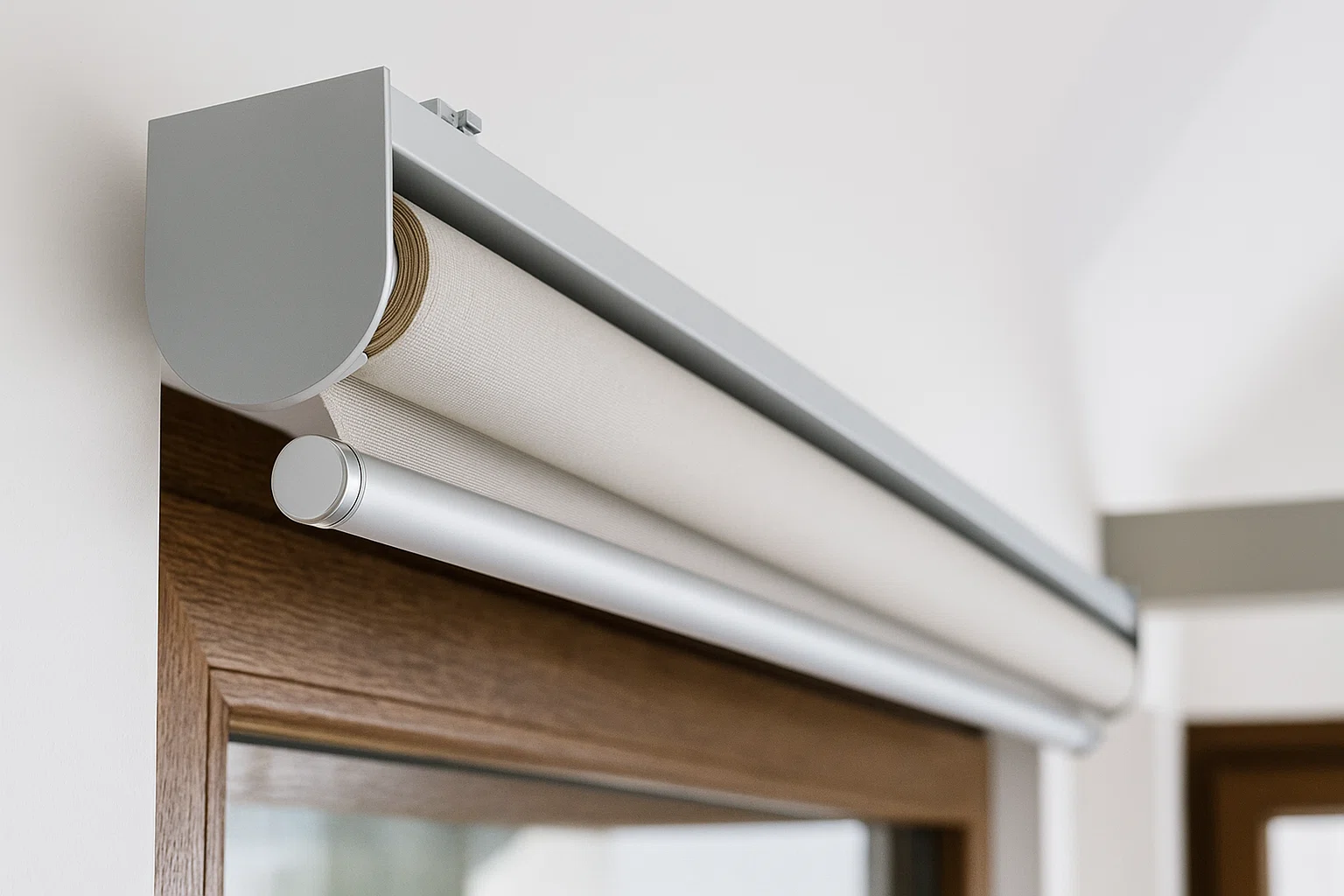
Cordless blinds replace external pull cords with spring-loaded or motorized mechanisms hidden inside the headrail.
For B2B buyers, the key is not just “cordless” as a marketing label, but the underlying
spring life, brake holding torque, noise level, safety compliance (ANSI/WCMA A100.1-2022), and
application fit (homes with children, hotel projects, smart-home users).
This guide walks through definitions, mechanism structure, scenario matching, installation checkpoints,
troubleshooting, safety standards, and 2025 trends such as solar motors, Thread/Matter, and recyclable blades,
so you can talk to suppliers with technical confidence.
1. What are cordless blinds? — Definition, mechanisms, and key specs
1.1 One-sentence definition
Cordless blinds are window treatments that remove external pull cords and rely on a
built-in spring-loaded system or a low-voltage motor hidden inside the headrail.
Users raise or lower the blind by pushing/pulling the bottom rail (manual) or via remote/app (motorized),
and the blind locks at any position without cord loops – improving child safety, visual neatness, and ease of operation.
1.2 Manual vs. motorized: how the mechanisms actually work
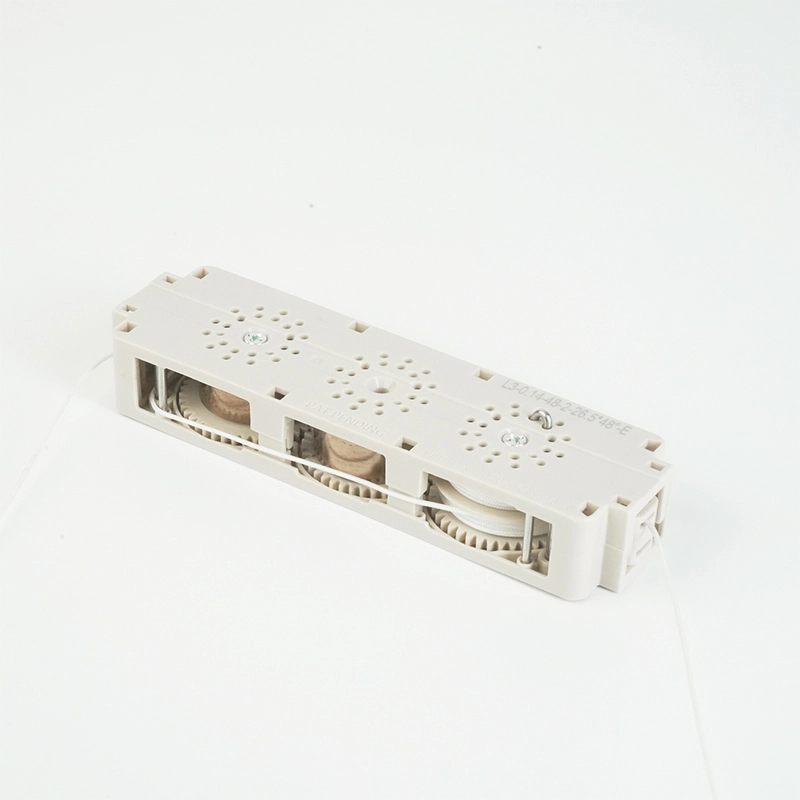
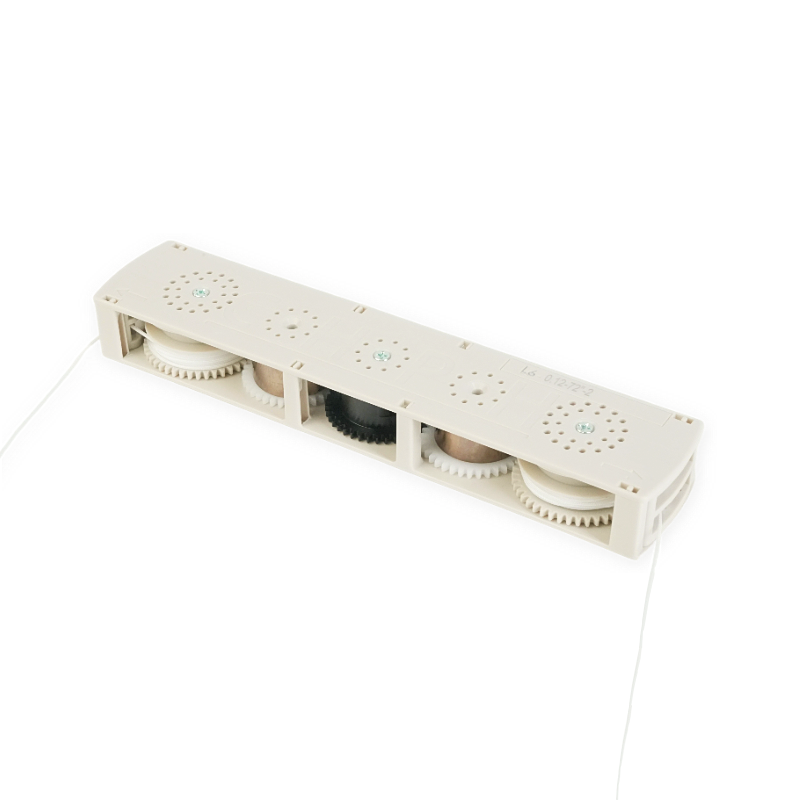
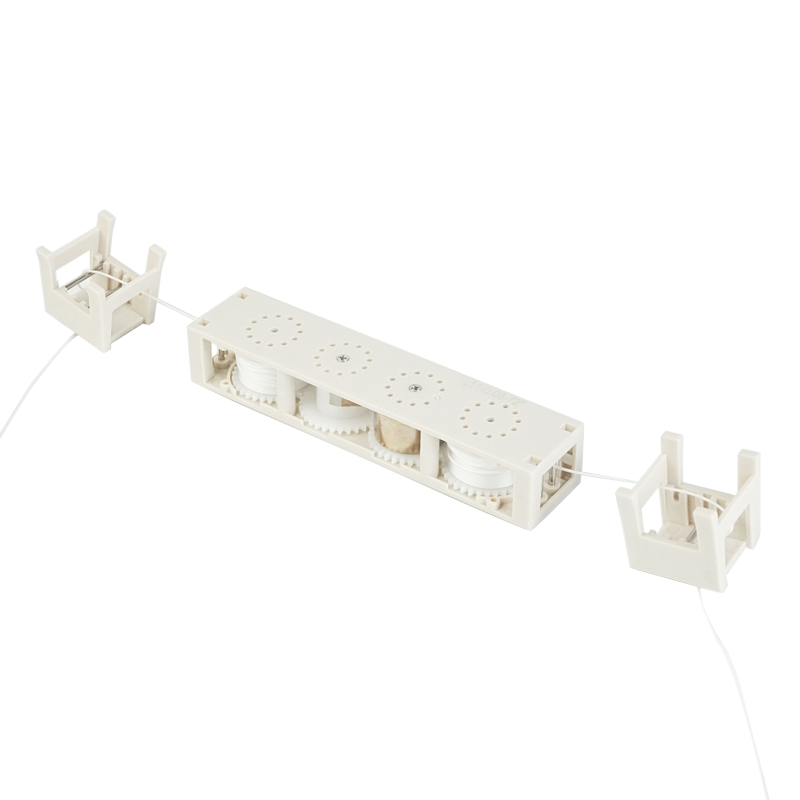
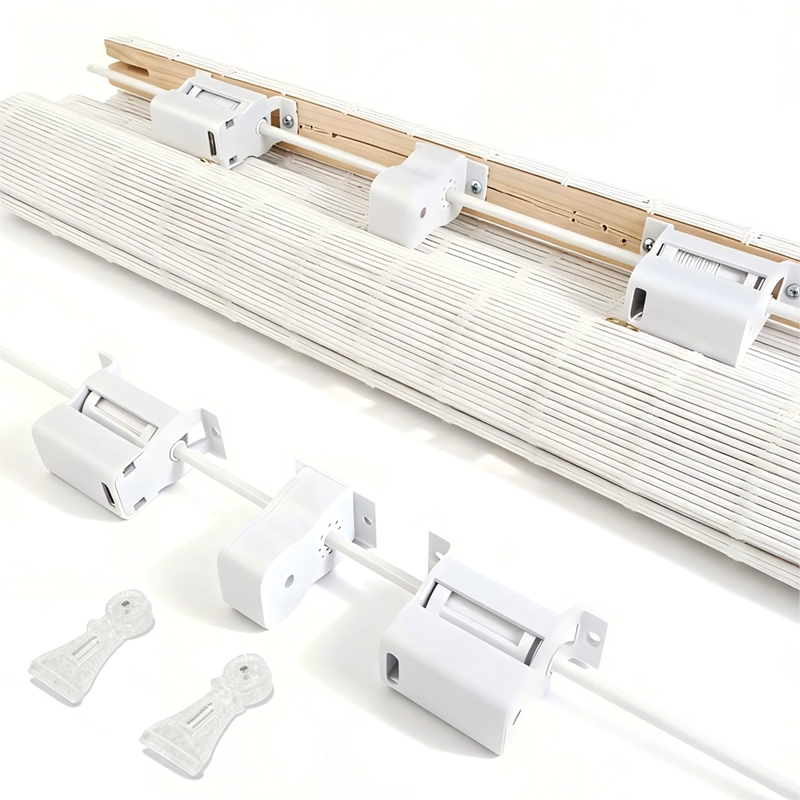
Manual cordless mechanism (typical architecture):
- Constant-force spring module:
pre-tensioned at the factory to store enough energy to balance the blind’s own weight,
enabling easy lift and “hover-anywhere” positioning. - Brake drum + one-way bearing:
acts as the locking unit. When the user stops pulling, the one-way bearing prevents reverse rotation;
friction keeps the rail locked and prevents sudden drop. - Gearbox / tilt mechanism (for Venetian styles):
converts lifting motion into a controlled rotation of the slats to achieve dimming from
full blackout to softly filtered daylight.
Motorized cordless mechanism (manual + electronics):
- Adds a DC motor for effortless lifting and group control of multiple blinds.
- Integrates a Hall sensor or encoder to measure travel and support
preset positions (e.g. “morning light,” “noon blackout,” “evening privacy”). - Connected via remote or app; higher-end versions support Thread/Matter for smart-home ecosystems.
1.3 Hard technical indicators buyers should ask about
When comparing suppliers, look beyond surface design and ask for these specs:
- Spring life: Better systems follow ASTM-style fatigue tests with
≥25,000 lift cycles – roughly 34 years of use at 2 cycles/day. - Brake holding torque / static load: Ensures the blind doesn’t creep down over time.
Ask for the minimum kg·cm or equivalent design value and the safety factor used. - Noise level: For bedrooms and hotels, target
≤42 dB at 1 m during operation. - Operating force: For child-safe comfort, a good manual cordless blind should stay under
roughly 30 N pull-down force across most of the stroke.
2. 7 mainstream window treatments in 5 minutes — What your customers compare against
End-users rarely see “mechanisms”; they see product types.
For B2B buyers, understanding where cordless blinds sit among alternatives helps build a complete category portfolio.
| Window Treatment Types | Operation | Shading | Suitable for | Core Advantages | Potential Disadvantages |
| Cordless Blinds | Manual lift / Motor control | 0–100% adjustable | Homes, bedrooms, hotels | No cords, safer, clean façade, flexible dimming | Higher cost vs. basic corded |
| Traditional Corded Blinds | Cord lift + cord tilt | 0–100% adjustable | Budget projects, some offices | Low cost, mature supply chain | Cord loop entanglement risk; tightening safety rules |
| Roller Blinds | Chain or motor | Medium–high; often blackout | Kitchens, bathrooms, offices | Simple look, easy cleaning | On/off style light; dimming less fine |
| Cellular (Honeycomb) Blinds | Cord / Cordless | Semi to full blackout | Bedrooms, living rooms | Thermal and acoustic insulation | Cells can trap dust; harder to clean |
| Roman Blinds | Usually corded | Mostly semi-shading | Decor-driven living spaces | Soft fabric look, many styles | Slower lift, less precise blackout |
| Vertical Blinds | Cord + tilt wand | 0–100% adjustable | Large windows, lobbies | Good for wide spans, flexible stacking | Vanes can warp, sway in strong wind |
| Shangri-La / Sheer Shades | Cord + tilt | 0–100% adjustable | Premium living, studies | Soft light, upscale appearance | High price, delicate fabrics |
3. Inside the cordless blind: core components and why they matter for sourcing
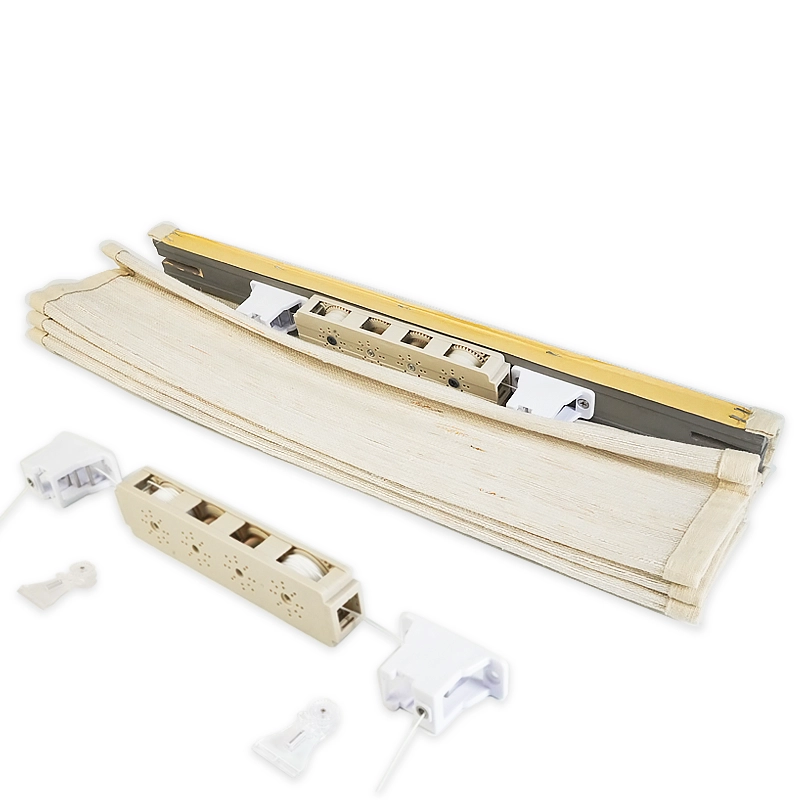
3.1 Core components from top to bottom
Mature suppliers should be able to tell you not only “what material,” but also “why this spec.”
Below is a simplified view of the key bill of materials.
| Component | Typical Material | Core Function | What Buyers Should Check |
| Head Rail | 6063-T5 aluminum, ~1.2 mm, anodized | Houses all internal parts and bears load | Wall thickness, surface treatment, deformation resistance |
| Spring Module | SUS301 or 65Mn, ~0.3–0.4 mm | Energy storage & balancing force | Cycle life, fatigue test method, environment rating |
| Brake Drum | POM + glass fiber | Locking, non-slip holding | Static load test value, one-way bearing quality |
| Lift Cord / Tape | High-tenacity yarn (e.g. Kevlar) | Transmit lift between rails | Breaking force, UV resistance, abrasion test |
| Tilt Rod / Mechanism | Reinforced ABS + reed or Hall sensor (for motorized) | Rotate slats for dimming | Backlash, angle accuracy, noise |
| Bottom Rail | Aluminum profile + foam tape | Weighting, stability, impact noise control | Straightness, surface finish, end caps |
3.2 Why the blind doesn’t slip down: a simplified mechanical check
A common concern from retail customers is “Will it suddenly fall?”
For buyers, the main thing is that the supplier has done the math and testing.
Example: assume a total blind weight of 1.1 kg, spring torque of 0.45 N·m,
brake drum radius of 9 mm, and static friction coefficient of 0.18.
A simplified calculation shows that the designed locking force can reach several times the real load.
In practice, engineers design a safety factor ≈2–3, so even under extreme conditions the system locks before the blind can drop,
following the “fail-safe” principle.
4. Scenario matching: how different buyers should choose cordless mechanisms
Different B2B customers prioritize different things:
parents care about child safety and cleaning,
programmers care about smart control, and
hotel purchasers care about fire codes and durability.
Treat your cordless system portfolio as a matrix to match these needs.
| Target Group | Core Needs | Recommended Style | Key Specs / Selling Points | What to Avoid |
| Mothers w/ kids & pets | No exposed cords, low VOC, easy cleaning | Cordless cellular or cordless faux-wood blinds | OEKO-TEX fabrics, no external cords, wipe-clean surfaces | Fuzzy fabrics that trap pet hair |
| Programmers / home office users | Glare control, insulation, smart-home integration | Solar-powered motorized Venetian or roller | UPF ≥50+, solar charging, Thread/Matter, app + voice control | Non-standard protocols; check that solar panel orientation works |
| Hotel & hospitality buyers | Fire safety, warranty, easy bulk cleaning | Cordless verticals or robust blackout rollers | NFPA 701 or equivalent, 5-year warranty, detachable vanes | Suppliers without test reports or on-site installation support |
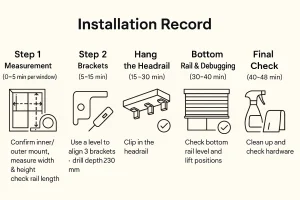
5. Installation record: what buyers should insist on during on-site fitting
Cordless blinds are installable by end-users, but for B2B projects the
installation process is part of product quality.
Below is a condensed record for three standard windows (1.2 m × 1.8 m) that you can turn into
an installation SOP with your supplier.
- Step 1 – Measurement (0–5 min per window)
Confirm inner/outer mount, measure width & height (tolerance ≤5 mm),
and check that rail length matches frame type. - Step 2 – Brackets (5–15 min)
Use a level to align 3 brackets in one horizontal line (error ≤2 mm); drill depth ≥30 mm
so expansion screws stay tight. - Step 3 – Hang the headrail (15–30 min)
Clip in the headrail, gently shake to test stability, and install slats (for Venetian) in the correct orientation. - Step 4 – Bottom rail & debugging (30–40 min)
Check bottom rail for level (left/right height difference ≤1 mm), then test:
three lift positions (must lock), and smooth dimming without jamming. - Step 5 – Final check (40–48 min)
Clean up, re-check for noise, and confirm that all hardware is firmly seated.
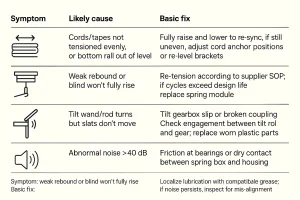
6. “Emergency room” for faults: simple field fixes buyers should expect
Over time, even good cordless systems may show minor issues.
A supplier that can provide clear “symptom → cause → fix” guidance will save you after-sales cost.
- Symptom: blind stuck or uneven left/right
Likely cause: cords/tapes not tensioned evenly, or bottom rail out of level.
Basic fix: fully raise and lower to re-sync; if still uneven, adjust cord anchor positions or re-level brackets. - Symptom: weak rebound or blind won’t fully rise
Likely cause: spring pre-tension insufficient, or spring near end of life.
Basic fix: re-tension according to supplier SOP; if cycles exceed design life, replace spring module. - Symptom: tilt wand/rod turns but slats don’t move
Likely cause: tilt gearbox slip or broken coupling.
Basic fix: check engagement between tilt rod and gear; replace worn plastic parts as needed. - Symptom: abnormal noise >40 dB
Likely cause: friction at bearings or dry contact between spring box and housing.
Basic fix: localized lubrication with compatible grease; if noise persists, inspect for mis-alignment.
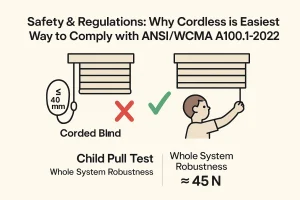
7. Safety & regulations: why cordless is the easiest way to comply with ANSI/WCMA A100.1-2022
7.1 Cord loops, 40 mm rule, and why cords are being phased out
ANSI/WCMA A100.1-2022 introduces strict rules on cord loops.
In short, any accessible loop circumference must be ≤40 mm, or it must
automatically break apart under a defined pull to reduce child strangulation risk.
Traditional corded blinds need extra hardware and third-party tests to pass this.
Cordless blinds sidestep this entirely — no exposed loops, no cord-loop testing,
and much lower recall risk. For exporters to the U.S., cordless is usually the
lowest-friction path to compliance.
7.2 Child pull test: whole system robustness
Even without cords, cordless systems must withstand a simulated child pull
(e.g. ≈45 N for 10 seconds) without loose parts or sudden drop.
When evaluating suppliers, ask whether they perform this test by model and to see at least
one full test report or lab certificate.
8. 2025 trends: solar motors, Thread/Matter, and recyclable blades
8.1 Solar-powered motors
By 2025, integrating flexible solar panels into the headrail or glass-side
is becoming standard for premium cordless blinds. For buyers, this means:
- No need to pull power cables to every window; easier retrofit projects.
- Battery life often specified at 6–12 months on typical usage.
- Marketing angle: energy saving and reduced maintenance visits for battery replacement.
8.2 Thread/Matter smart-home protocol
Legacy Wi-Fi/Bluetooth blinds often suffer from pairing issues in real homes.
Newer cordless motors using Thread/Matter can join Apple, Google, Amazon,
and other ecosystems more smoothly, with:
- Cross-platform compatibility instead of brand-locked systems.
- Low latency (target response ≤0.5 s) and lower power use.
- Cleaner integration into “good morning/good night” automation scenes.
8.3 Recyclable slats and modular design
To align with sustainability and ESG goals, some brands are moving toward
PP or other recyclable materials instead of pure PVC/fiberglass slats.
Others are developing modular systems where slats, rails, and spring boxes can be
disassembled for separate recycling.
When sourcing, buyers can request:
material declarations, recyclability information, and take-back/repair programs
as differentiators in key accounts and tender bids.
Xiamen Dosron Intelligent Co., Ltd.
for engineering-driven solutions built around your target market and channels.
FAQ for buyers sourcing cordless blinds from suppliers
Q1: What realistic lifespan should I expect from manual vs. motorized cordless blinds?
A: For manual spring-driven systems, a 25,000-cycle spring test is a strong benchmark,
equivalent to decades of typical household use.
For motorized systems, quality DC motors tested into the millions of cycles can support
10–15 years of service in normal residential applications, assuming proper installation and load matching.
Q2: Can cordless blinds be used in bathrooms or high-humidity areas?
A: Yes, but request moisture-resistant materials:
foam PVC or ABS blades instead of fabric, and spring boxes with anti-corrosion coating
(or stainless spring steel plus protective finish).
Ask suppliers whether they perform high-humidity exposure tests (e.g. 95% RH for several days)
without rust or deformation.
Q3: How much more expensive are cordless blinds compared with corded?
A: As a rough guide for 1.2 m × 1.8 m sizes:
traditional corded might run USD 20–30,
manual cordless USD 30–45,
and motorized cordless USD 60–100 depending on smart features.
For many projects, this premium is justified by compliance, safety, and positioning.
Q4: What should be clearly written into my purchase contract?
A: At minimum:
technical spec sheet (materials, spring cycles, noise, test standards),
warranty coverage (do springs and motors have separate terms?),
after-sales response time (e.g. first reply within 24 hours, solution within 72 hours),
and requirements for installation training or manuals that you can pass to installers and end-users.
10. Conclusion: Turning cordless mechanisms into a sourcing advantage
For today’s window covering brands and importers, “cordless” is no longer a niche add-on;
it is fast becoming the default answer to safety standards and consumer expectations.
Understanding the underlying spring mechanisms, brake design, material choices, and regulatory requirements
helps you screen suppliers more efficiently, reduce recall risk, and position your portfolio at a higher level.
When you evaluate potential partners, look for those who can explain
mechanism architecture, test methods, and scenario-based recommendations in detail,
not just quote prices.
If you need customized spring systems, cordless modules, or motor options for roller, cellular, or Venetian blinds,
you can always reach out to specialized manufacturers such as