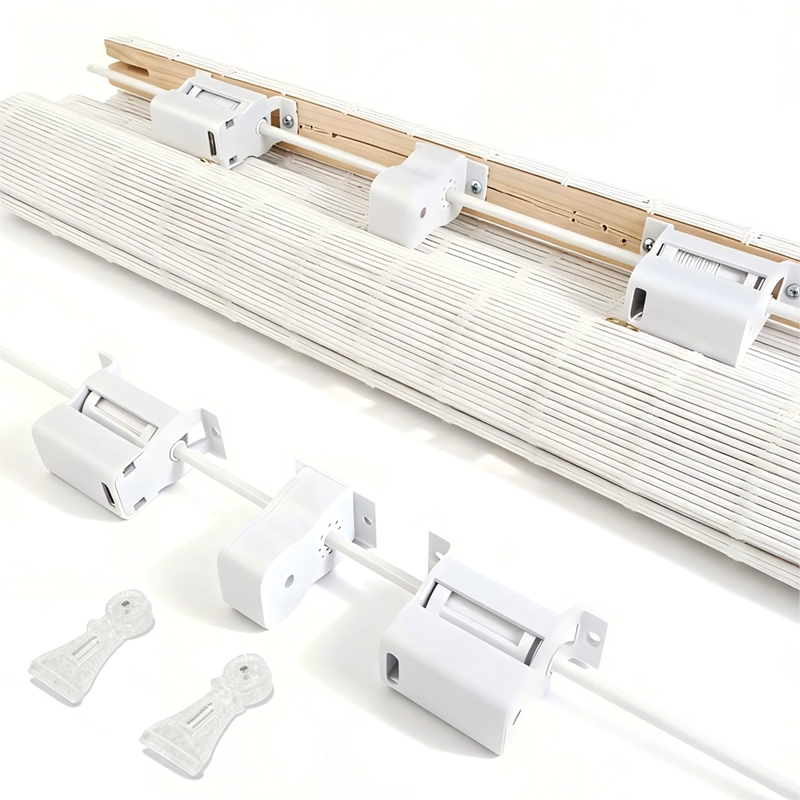
How Do Spiral Torsion Springs Power Cordless Roller Shades?
Intruduction
In modern mechanical systems and consumer products,
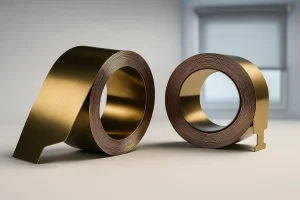
spiral torsion springs (also called clock springs, constant-force springs, or scroll springs) act as compact “energy batteries.”
Their spiral metal strips store energy through bending and release it as stable torque or linear force.
This combination of high energy density, compact geometry, and repeatable force output makes them indispensable in
mechanical watches, automotive seatbelts, medical and industrial equipment, and today’s
cordless roller shades.
 |
 |
With the global shift from corded blinds to cordless systems for child safety and aesthetics,
understanding how spiral torsion springs work – and how to design and manufacture them correctly –
has become a core competency for shade manufacturers and component suppliers.
I. What Are Spiral Torsion Springs?
A spiral torsion spring is a long, thin metal strip (or wire) coiled into a spiral around a center.
When external torque is applied, the strip bends, the spiral tightens or loosens, and energy is stored as elastic strain.
After the external force is removed, the strip tends to recover, releasing this energy and delivering either torque or a nearly constant linear force.
1.1 Key Characteristics
- Spiral geometry & stable output:
The strip bends rather than stretches like a coil spring.
With proper design, the force curve can be linear or nearly constant, which is ideal for balancing the weight of a roller shade panel. - High space efficiency:
A 50–80 mm spiral can balance a 1.5–2 m lifting stroke, making it suitable for narrow headrails and compact mechanisms. - Fatigue resistance:
Quality springs survive tens of thousands to over 100,000 cycles without plastic deformation, supporting the long service life required in
cordless roller shades and seatbelt retractors.
1.2 Materials Used
Material selection depends on load, environment, and life expectation.
Engineers usually trade off three dimensions: strength, elasticity, and weather resistance.
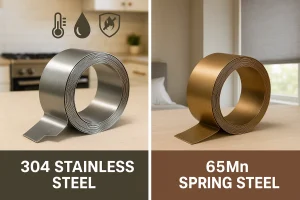
- 65Mn spring steel: high elastic modulus and fatigue strength, cost-effective for dry indoor environments
(e.g., bedroom roller shades). - 304 stainless steel: better corrosion resistance, suitable for
kitchens and humid rooms where oil and moisture are present. - 316 stainless steel or 65Mn with Dacromet coating:
used in bathrooms or coastal regions where salt spray resistance is important.
For a 5 kg cordless roller shade, a typical design uses a strip thickness of
0.3–0.4 mm and a width of 15–20 mm to balance strength, force, and radial size.
1.3 Historical Background
The evolution of spiral torsion springs mirrors the evolution of precision energy storage:
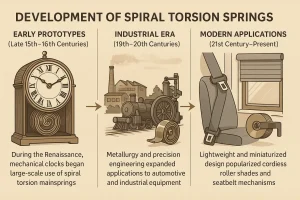
- Renaissance clocks (15th–16th centuries):
Coiled mainsprings replaced hanging weights, enabling portable table clocks and watches. - Industrial era (19th–20th centuries):
Improved steel and machining brought springs into automotive seatbelts, valves, and machine tools. - Modern era (21st century):
Lightweight, low-noise, long-life designs power compact consumer devices and
cordless window coverings, which remove hazardous pull cords and improve user experience.
II. Types of Spiral Torsion Springs
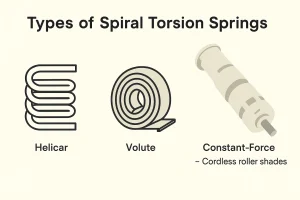
Based on structure, force behavior, and applications, spiral torsion springs are typically grouped into three families.
All appear in industrial design, but constant-force springs are the core type for cordless roller shades.
2.1 Power-Type Spiral Torsion Springs (Clock Springs)
Power-type springs are optimized for maximum energy storage.
A uniformly thick strip is wound from smaller to larger radii. When wound tighter, it stores energy; during release, it drives a mechanism through torque.
Typical uses: mechanical watch mainsprings, wind-up toys, hand-crank flashlights, and small emergency devices.
2.2 Constant-Force Spiral Torsion Springs (Balance Springs)
Constant-force springs aim for stable, nearly constant force output over their working stroke.
Through “equal-stress” strip design and controlled coiling, force fluctuation can be kept within about ±5%.
This makes them ideal to counterbalance roller shade weight.
Design highlights:
- Uniform strip cross-section and controlled coiling radius.
- Strip thickness, width, elastic modulus, and effective turns tuned to match load.
- Often used with a sliding or no center shaft, one end fixed to the housing and the other to the moving reel.
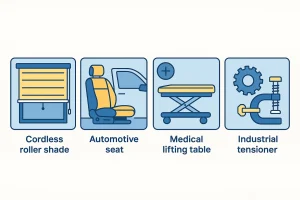
Key applications: cordless roller shades, automotive seat adjusters, medical lifting tables, and industrial tensioners.
2.3 Double-Direction Spiral Torsion Springs (Bidirectional Springs)
Bidirectional designs combine two spirals wound in opposite directions on a common shaft or housing.
They can store and deliver torque clockwise and counter-clockwise, enabling two-way reset.
They require careful force matching and often finite element analysis to avoid one-sided jamming.
Typical applications include bidirectional door hinges, valves with reversible actuation, and precision tools with two-way positioning.
III. Mechanical Principles of Spiral Torsion Springs
3.1 Bending Deformation & Elastic Recovery
Unlike coil springs that mainly work in tension or compression, spiral torsion springs work in
pure bending. Under torque, the strip bends and stores elastic energy. Once released, the strip recovers and drives the mechanism.
For constant-force springs used in roller shades, the approximate linear force F can be written as:
F = (E × b × t³) / (4 × R³ × n)
where E is elastic modulus, b the strip width, t the strip thickness,
R the mean radius, and n the number of effective coils.
The cubic relationship with t shows how small changes in thickness strongly affect force.
3.2 Energy Storage & Release
The elastic potential energy U stored in the spring over a deformation stroke s is:
U = (1/2) × F × s
For cordless roller shades, s is roughly the lifting height (often 1.5–2.5 m).
In practice, design does not push the strip to its absolute elastic limit; a margin of about 10–15% is reserved to avoid plastic deformation
and ensure long life.
In operation, the goal is not only to have “enough energy” but to release it in a controlled, quiet way.
Excessive release speed causes the shade to slam into the headrail; too little causes jamming.
Engineers therefore pair the spring with a damping mechanism and refine the force curve through strip geometry.
3.3 Factors Affecting Performance
Key influencers for constant-force springs in roller shades include:
- Material properties:
Elastic limit and fatigue strength set allowable stress and life.
Design stress is usually kept at ≤70% of the elastic limit and fatigue life targeted at ≥100,000 cycles. - Dimensional accuracy:
Thickness tolerance often ≤±0.01 mm and width tolerance ≤±0.05 mm.
Poor control leads to large force variation and unbalanced shades. - Coiling precision:
Concentricity error should be small (≈0.1 mm) and coil spacing consistent to avoid noise and accelerated wear. - Working environment:
Temperature range (–20 °C to 60 °C), humidity, and contaminants all affect force and corrosion behavior.
IV. Application Scenarios of Spiral Torsion Springs
Spiral torsion springs appear wherever compact, repeatable torque is required.
Below are the most important scenarios, with a focus on cordless roller shade systems.
4.1 Cordless Roller Shade Systems
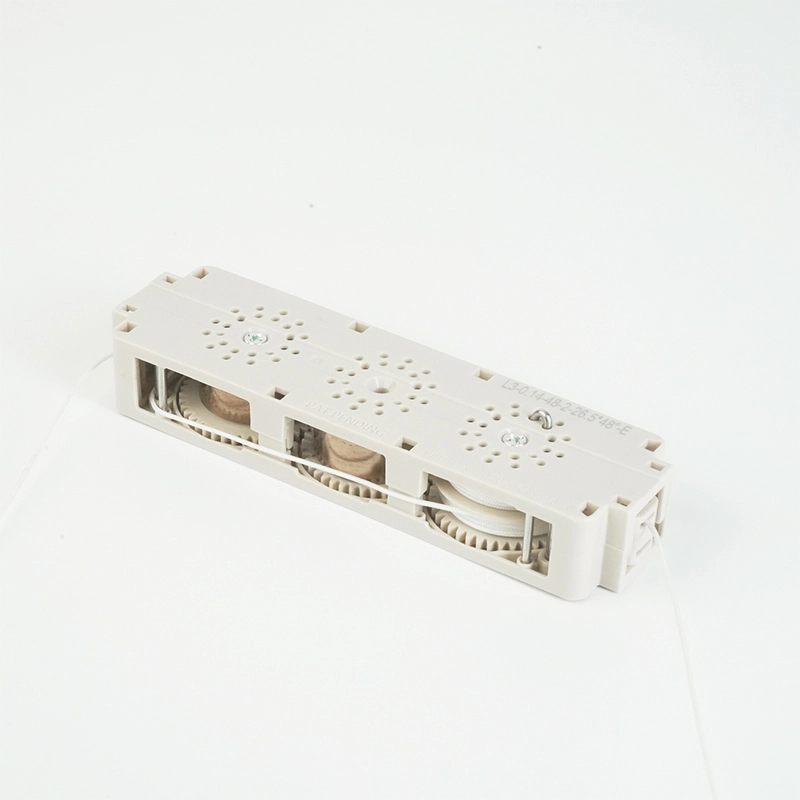
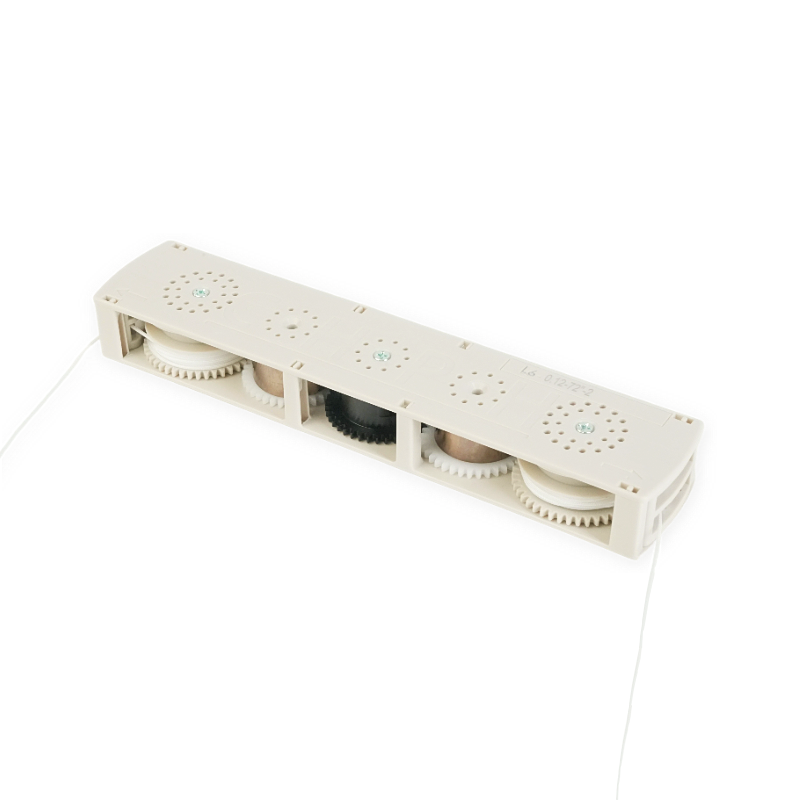
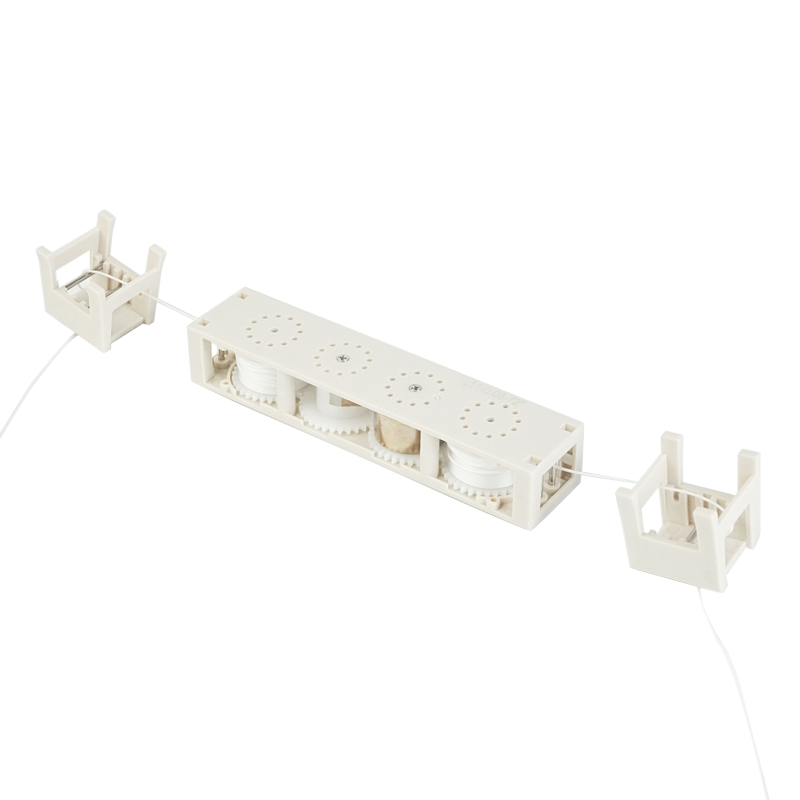
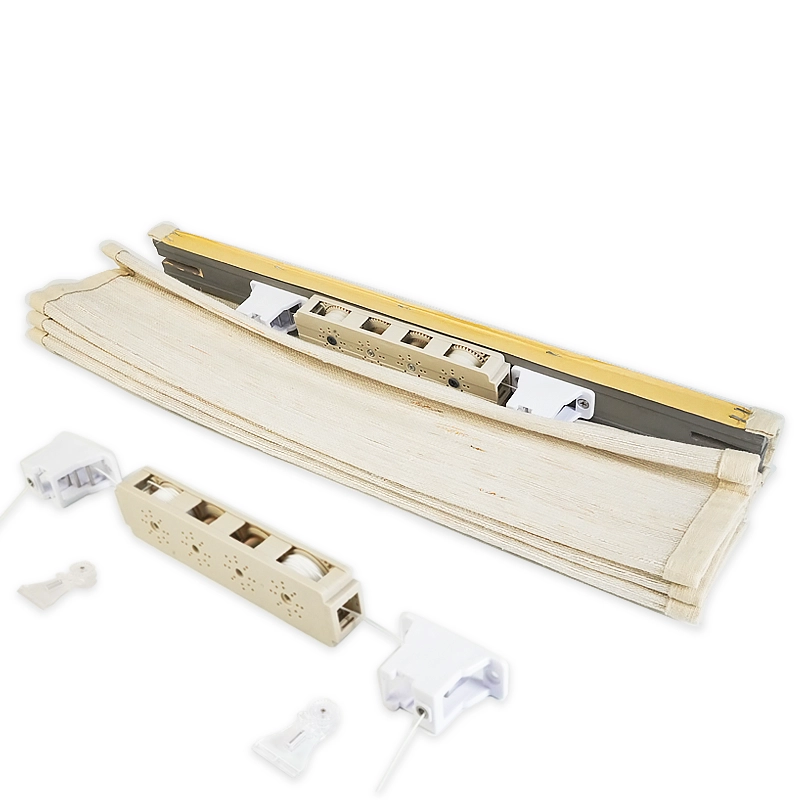
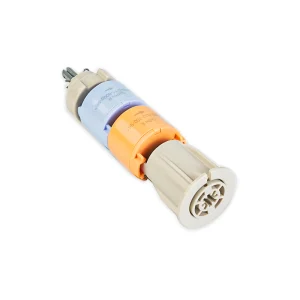
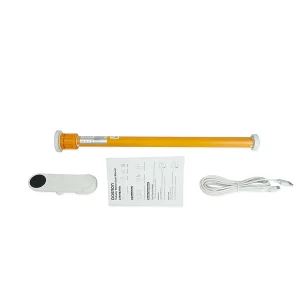
A cordless roller shade typically consists of a spiral torsion spring, reel, damping unit, and bottom bar.
The spring and reel are housed inside the headrail or tube.
- Lowering: pulling the bottom bar rotates the reel, winding the spring and storing energy while the fabric unrolls.
- Raising: releasing the bar allows the spring to unwind, rotating the reel in the opposite direction and lifting the fabric.
- Balance & comfort: a damping system and carefully tuned spring ensure
easy pull-down (<≈30 N), gentle rise (≈0.1–0.2 m/s), and low noise (≈35 dB or less).
 |
|
Why constant-force springs?
The fabric and bottom bar weight form a roughly constant load over the stroke.
Constant-force springs match this behavior, so the user feels uniform force through the full travel.
Power-type springs have larger torque variation and are harder to tune for smooth shade movement.
Design logic for roller shades (simplified):
- Calculate total load (fabric + bottom bar) and add a safety factor for friction.
For example, a 1 m × 2 m PVC shade with 1.2 kg/m² density plus a 0.8 kg bar
results in a total force of roughly 35 N. - Choose strip thickness and width using the force formula, limiting outer diameter to the headrail envelope
(often ≤80% of internal height). - Verify life and force curve through testing; fine-tune through small adjustments to thickness, effective turns, or damping coefficient.
Correctly designed, a cordless shade can be operated comfortably by children and the elderly,
while eliminating hazardous exposed cords.
4.2 Automotive Industry
Automotive systems demand safety, reliability, and resistance to harsh conditions.
Spiral torsion springs are found in:
- Seatbelt retractors:
Constant tension keeps the belt close to the body during normal driving, while emergency locking mechanisms engage during a crash. - Seat height and angle adjusters:
Springs counterbalance the seat mass, so users can adjust position with low effort. - Door checkers:
Springs and cams control the opening angle and closing force, letting doors stay open in intermediate positions
and close smoothly when pushed beyond a threshold.
4.3 Precision Instruments
In mechanical watches and scientific instruments, spiral torsion springs provide precise, low-error power output.
Mainsprings in watches must deliver torque with small fluctuation (often within ±8%) over dozens of hours,
while fitting into extremely small volumes.
4.4 Industrial Machinery
In industrial environments, spiral torsion springs handle higher loads and duty cycles:
- Valves: springs provide automatic reset when control signals disappear, protecting pipelines.
- Textile machinery: constant-force springs maintain even yarn tension, preventing breakage.
- Robotics: springs can partially counterbalance joint weight to ease motor load and improve efficiency.
V. Design & Manufacturing of Spiral Torsion Springs
High-performing spiral torsion springs result from a closed loop of
demand analysis → parameter calculation → simulation → prototype → mass production.
Below is a condensed view with emphasis on cordless roller shades.
5.1 Design Workflow
- Define requirements: energy, force, stroke, life, noise limits, environment, and maximum outer diameter/length.
- Select material: choose among 65Mn, 304, 316 or coated steels, balancing elasticity, fatigue strength, corrosion resistance, and cost.
- Calculate structural parameters: strip thickness, width, mean radius, and effective turns using the force equation and headrail constraints.
- Simulate: use FEA to confirm stress levels, force curve shape, and predicted fatigue life over the working stroke.
- Prototype & test: build samples, measure force curve, run accelerated life tests (e.g., 100,000 cycles), and tune parameters as needed.
5.2 Manufacturing Highlights
A typical manufacturing route includes:
- Strip preparation: precision cutting, ultrasonic cleaning, and straightening
(straightness error ≤0.1 mm/m). - CNC coiling: dedicated coiling machines control radius and spacing.
For shade springs, coil spacing error is usually kept within 0.05 mm and concentricity within 0.1 mm. - Heat treatment: quenching and tempering tailor hardness
(often HRC42–45) and relieve internal stress. - Surface treatment: galvanization, plastic coating, Dacromet, or PTFE coating
provide corrosion resistance and lower friction. - Finishing & assembly: deburring, end-geometry shaping, welding of anchors or snaps,
and fine dimensional correction. - Quality inspection: dimensional checks, force-curve sampling, fatigue and salt-spray tests, and 100% visual inspection.
5.3 Trends in Advanced Manufacturing
New materials and production technologies are pushing spiral torsion springs toward
higher precision, longer life, and smarter manufacturing.
Examples include high-strength spring steels with higher elastic limits, integrated coiling-plus-heat-treatment lines,
AI-assisted visual inspection for 100% full-inspection, and 3D-printed tooling for special geometries or extra-wide/extra-high shades.
VI. FAQ: Spiral Torsion Springs in Cordless Roller Shades
Q1. Why are constant-force spiral torsion springs preferred over other types?
Because they can keep force within roughly ±5% across the working stroke.
This near-constant output balances fabric weight, so users feel smooth motion without sudden heaviness or rapid snapping.
Power-type springs have larger torque variation, and double-direction springs add cost without benefit for one-way lifting.
Q2. What happens if the spring force does not match the shade weight?
If force is too low, the shade will not rise fully or will stop midway.
If force is too high (more than about 15% over weight), the user must pull hard and the shade may slam upward when released.
A good design sets spring force roughly 5–10% above total shade weight.
Q3. How should I choose materials for different rooms?
For dry bedrooms and living rooms, cost-effective 65Mn spring steel is usually sufficient.
For kitchens with oil and moisture, 304 stainless provides better protection.
For bathrooms and coastal or high-humidity environments, 316 stainless or Dacromet-treated spring steel offers enhanced corrosion resistance.
Q4. When should a shade spring be replaced?
Replace the spring if you see any of these signs: lifting failure or frequent jamming,
sharp noise above about 40 dB, visible rust or cracks on the strip, or when the product has clearly exceeded
its designed cycle life (commonly around 100,000 operations).
Q5. Does installation accuracy really matter that much?
Yes. If spring and reel are not coaxial, the spring runs eccentrically, which increases friction and force fluctuation.
A coaxiality error above about 0.2 mm can cause tilting, noise, and accelerated wear.
Good practice is to keep coaxiality around 0.1 mm and verify smooth rotation during installation.
Field Sight
Spiral torsion springs are small components with large impact.
Their ability to store and release energy via bending deformation, in a compact and durable form factor,
underpins the performance of countless modern products – from watches and automotive systems to
cordless roller shades.
In window coverings, they provide the technical foundation for safer, cord-free operation:
balancing panel weight, fitting inside narrow headrails, delivering long service life,
and keeping noise under control.
Achieving this requires careful integration of material science, mechanical design, precision manufacturing,
and application-specific testing.
For manufacturers and brand owners looking to upgrade from corded to cordless systems,
understanding spiral torsion springs is not just a mechanical topic – it is a direct path to
better safety, better user experience, and stronger market competitiveness.
More details about customized spring solutions for cordless blinds are available via our
contact page.