Why Are Spring-Assisted Cordless Roller Shades So Quiet, and How Do They Work?
Quick Summary
Spring-assisted cordless roller shades are quiet because a constant-force spring, sealed inside the tube, balances the fabric weight and works with damping parts to control speed and impact. Instead of noisy chains and clutches, you simply guide the bottom rail and the internal spring takes care of the lifting. Good materials, tight tolerances and tuned pre-tension keep noise in a low, steady range – especially important for bedrooms, nurseries and premium living spaces.
1. What Is a Spring-Assisted Cordless Roller Shade?
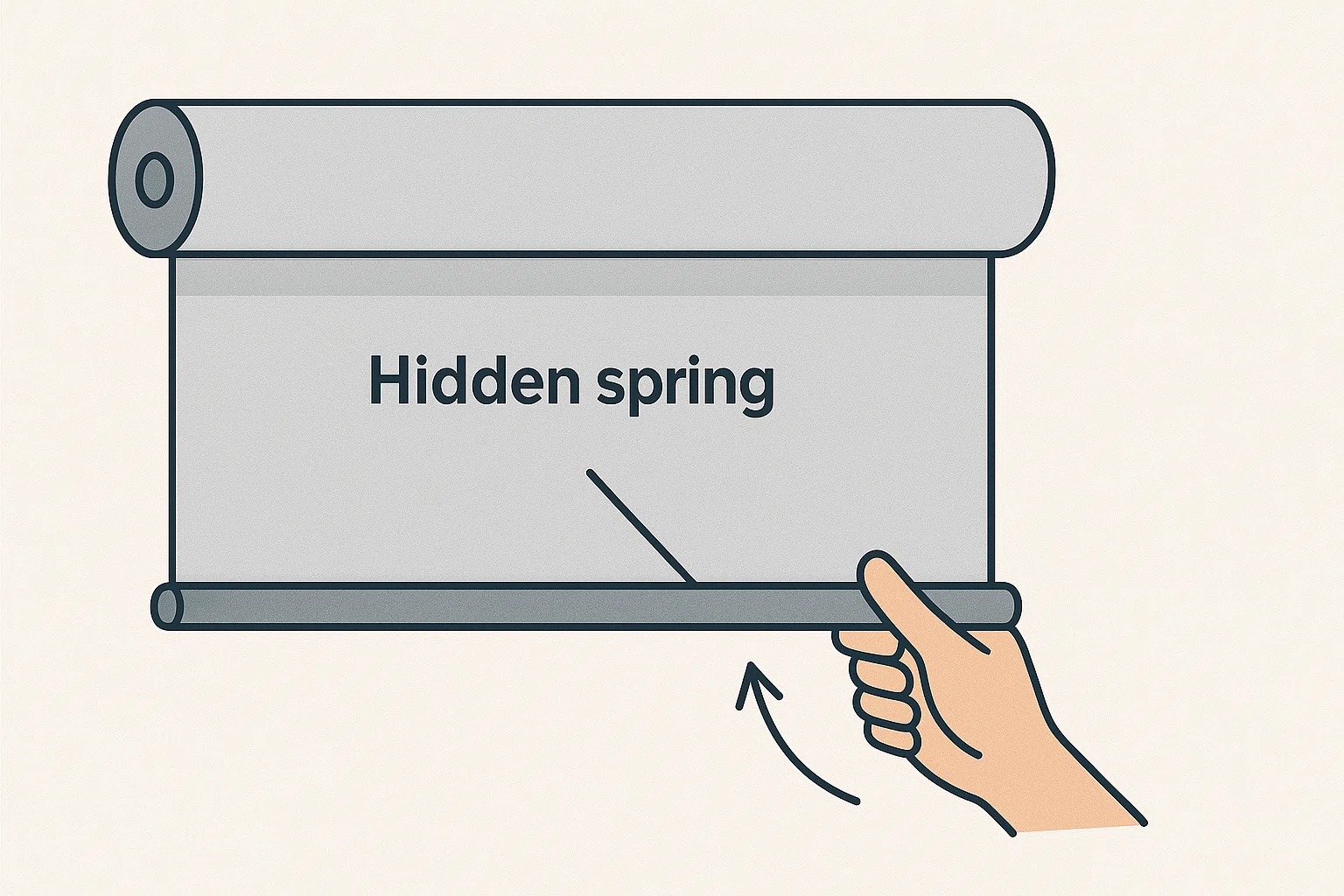
A spring-assisted cordless roller shade replaces the visible pull chain with a hidden spring mechanism that is built into the roller tube. This mechanism:
- Balances the weight of the fabric and bottom rail.
- Lets you move the shade by simply guiding the bottom rail up or down.
- Uses internal damping and brakes so the shade rises in a controlled way instead of snapping up.
In simple terms:
You pull the shade down → the spring stores energy.
You release → the spring gently pulls the shade back up.
No chain, no loose cords, no “clack-clack-clack” from a clutch — just smooth, cordless motion.
2. The Quiet Core: Constant-Force Spiral Spring
At the heart of most quality cordless systems is a constant-force spiral spring (often made from 301 stainless-steel strip):
- It is a long, thin strip of metal wound into a tight spiral coil.
- When you pull the shade down, the strip bends and winds tighter, storing energy.
- When you let go, it unwinds and drives the tube in the opposite direction to lift the fabric.
Unlike a traditional coil spring, a constant-force spring is designed so its force remains almost flat across the full stroke. That stable force curve makes the blind feel balanced and predictable from top to bottom, not “too heavy at first, too strong later”.
This is the first big reason these shades are quiet: no sudden surges of torque, less bouncing, and fewer hard impacts inside the headrail.

3. Inside the Tube: Components That Shape Noise
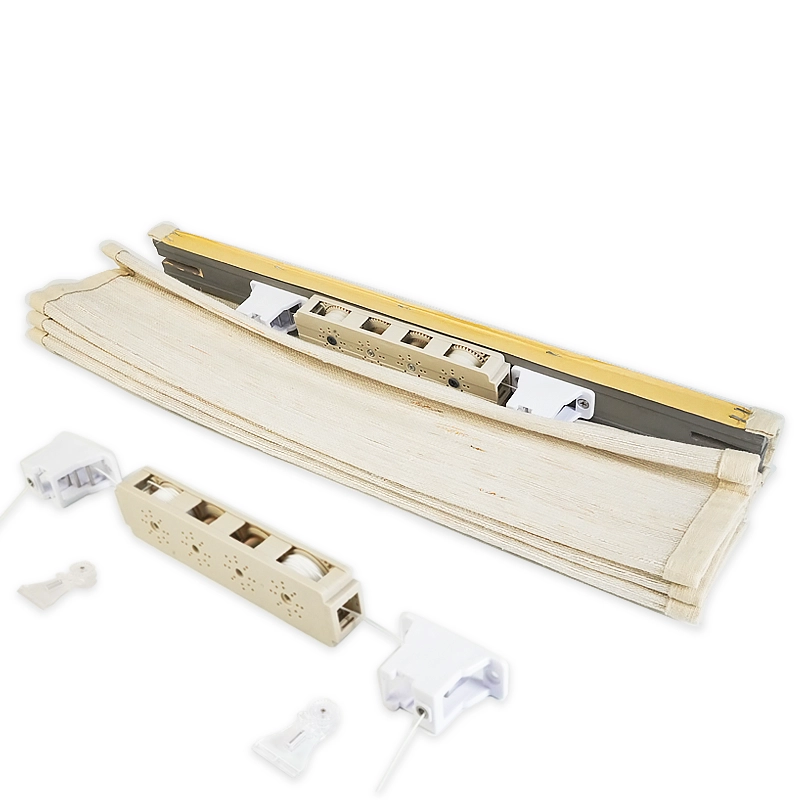
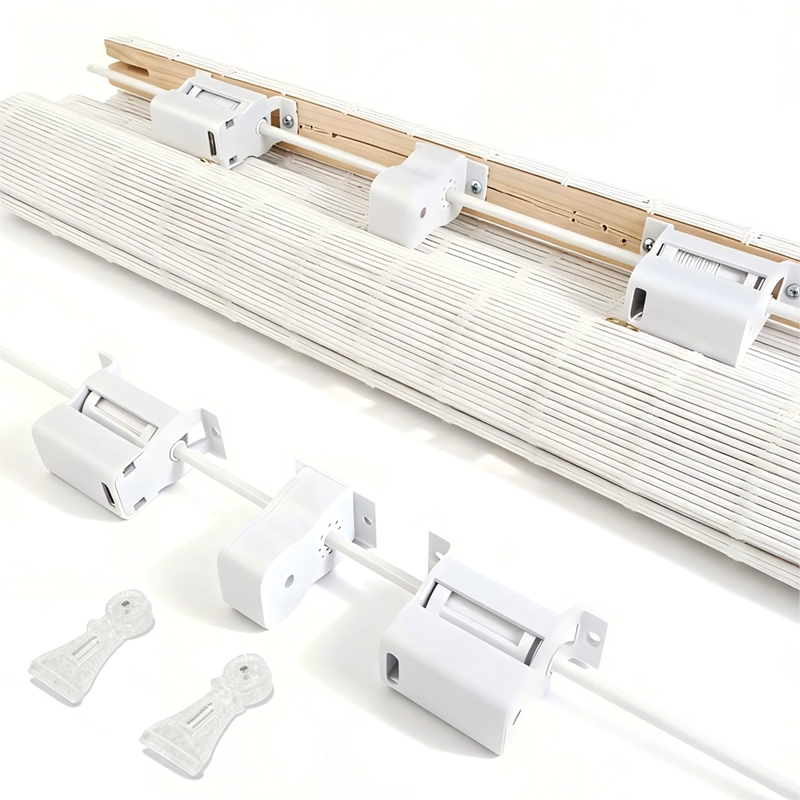
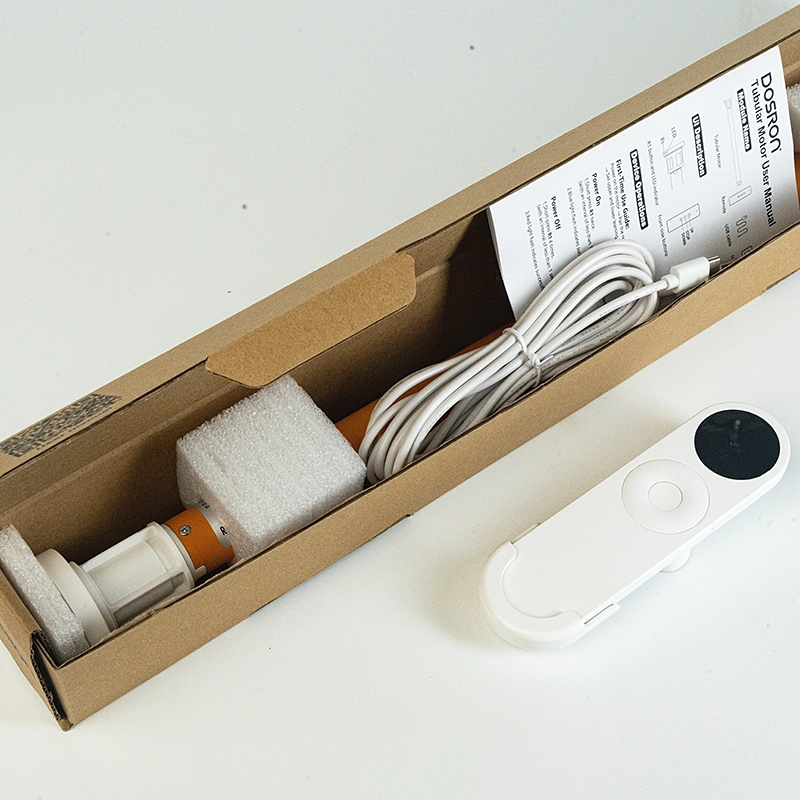
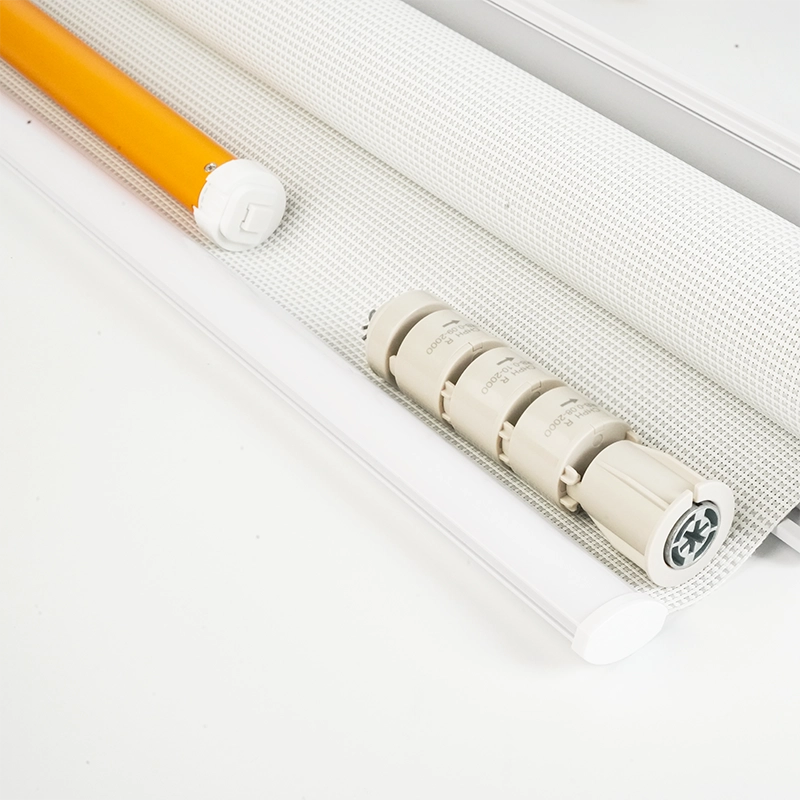
A typical spring-assisted cordless roller shade for Ø32 mm or Ø38 mm tubes is built from a few critical parts:
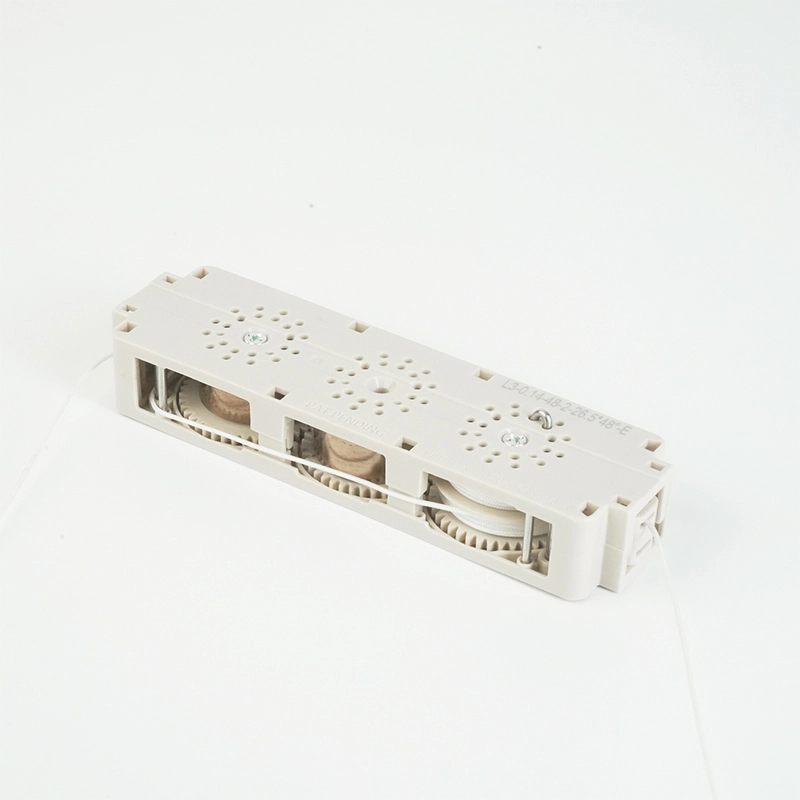
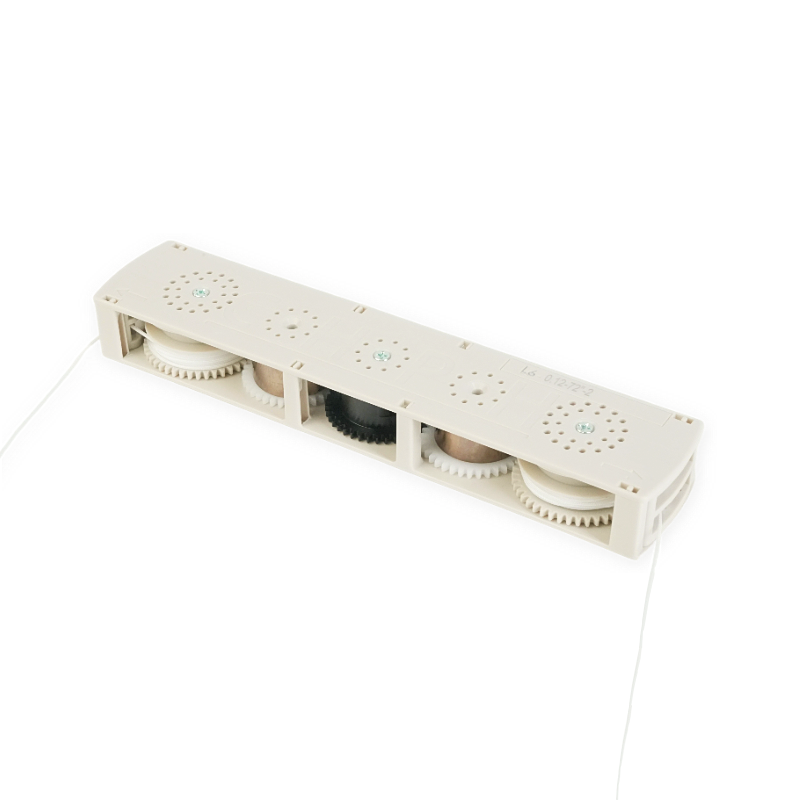
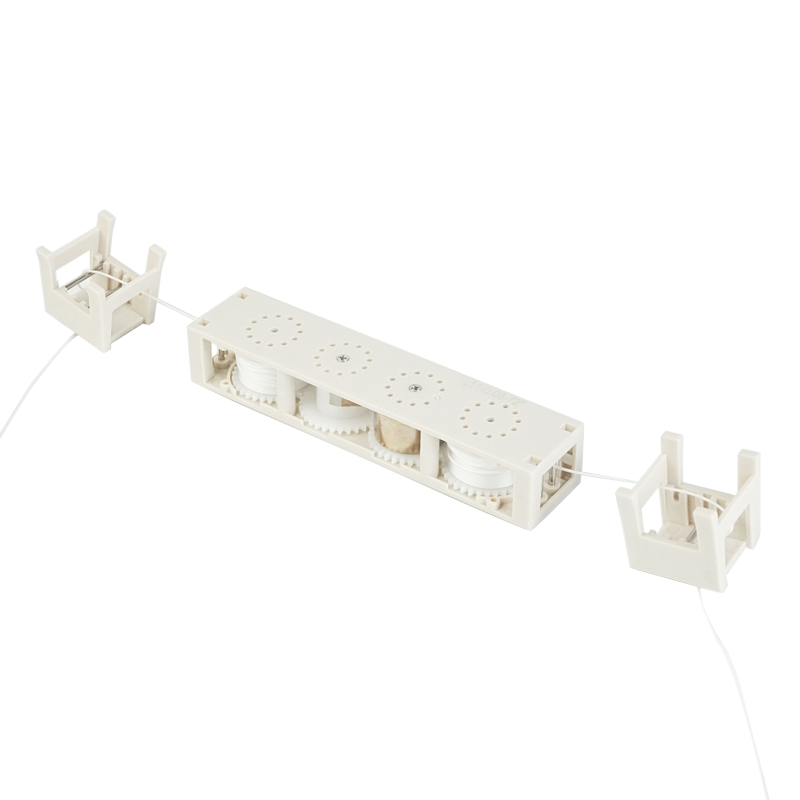
- Constant-force spring module
A spiral spring housed in a POM engineering plastic or metal cassette. This module provides lifting force and the “zero-gravity” feel. - Damping / brake elements
Friction pads or other damping parts that slow the tube rotation so the shade never shoots up too fast. - Roller tube
An aluminum tube that the fabric wraps around. One end connects to the spring cassette; the other to an idle plug or support. - Bottom rail (hem bar)
Adds weight to keep the fabric straight and stable. This is the part users hold to operate the blind. - Brackets and mounting hardware
Support the tube. If they are misaligned, they can easily become a source of rattle or scraping noise.
 |
 |
Every piece influences how quiet or noisy the final shade feels in real use.
Engineering Reference — Example Load & Spring-Force Matching
| Item | Parameter / Formula | Value | Unit | Notes |
|---|---|---|---|---|
| Fabric type | PVC blackout fabric | — | — | Typical for bedroom / nursery roller shades |
| Shade size | Width × Height | 1.0 × 2.0 | m | Example single window |
| Fabric density | ρfabric | 1.2 | kg/m² | Including coating / backing |
| Fabric mass | mfabric = ρ × W × H | ≈ 2.4 | kg | 1.2 × 1.0 × 2.0 |
| Fabric weight | Gfabric = m × g | ≈ 23.5 | N | g ≈ 9.8 N/kg |
| Bottom rail mass | mrail | 0.8 | kg | Typical aluminum hem bar |
| Bottom rail weight | Grail = m × g | ≈ 7.8 | N | 0.8 × 9.8 |
| Total base load | Gbase = Gfabric + Grail | ≈ 31.3 | N | Gravity load without safety factor |
| Design load with safety factor | Gtotal = Gbase × 1.1 | ≈ 34.5 | N | +10% to cover friction & tolerances |
| Recommended spring force | Fspring ≈ Gtotal | 34–35 | N | Constant-force spring matched to this window size |
| Tube diameter | Ø tube | 32 / 38 | mm | Common cordless roller shade tube sizes |
4. How the Mechanism Works Step by Step
4.1 When You Pull the Shade Down
- You grip the bottom rail and gently pull downward.
- The roller tube rotates as the fabric unwinds.
- The tube rotation winds the spiral spring tighter inside its cassette.
- The spring’s metal strip bends more, storing elastic potential energy.
- The damping or brake elements allow the movement but add drag, making the feel smooth instead of jerky.
Result: the shade lowers quietly. Any noise you hear is usually just soft fabric motion, not hard mechanical rattling.
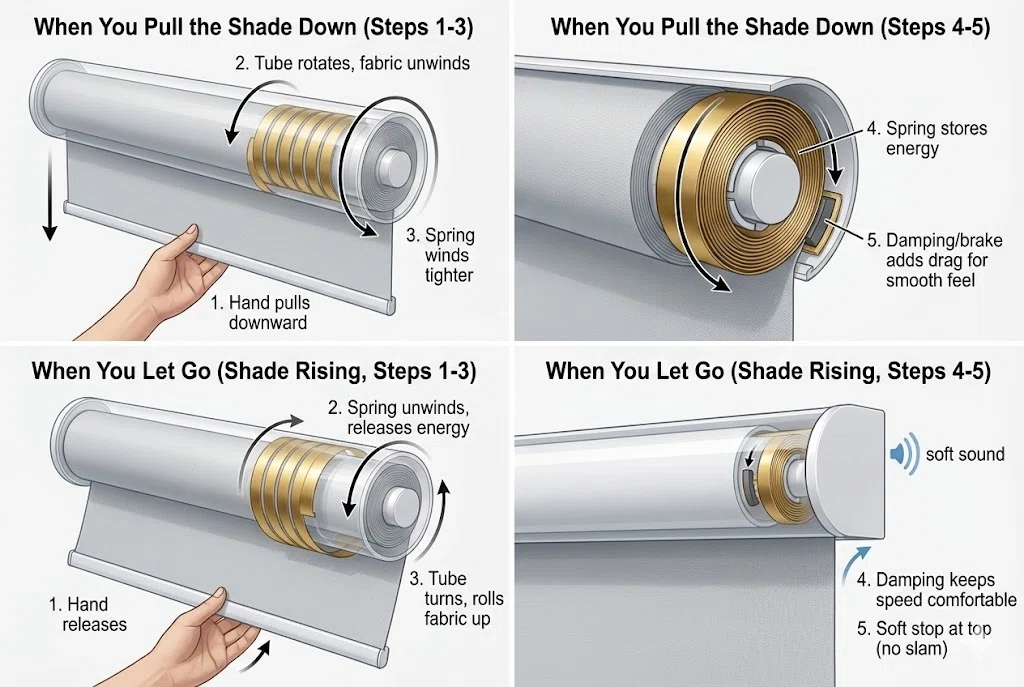
4.2 When You Let Go (Shade Rising)
- You release the bottom rail.
- The spiral spring begins to unwind, releasing the stored energy.
- This energy turns the tube in the opposite direction, rolling the fabric back up.
- The damping or brake elements work harder now to keep the speed comfortable, often around a gentle, steady rise.
- The system is tuned so the bottom rail does not slam into the headrail when it reaches the top.
Result: the blind glides up with a soft sound profile instead of snapping and banging.
5. Why Spring-Assisted Cordless Shades Are So Quiet
5.1 Calm Force Curve, Not Aggressive Torque
Because the spring is designed as a constant-force system, torque stays relatively stable throughout the stroke. That means:
- No sudden acceleration at any point during travel.
- No violent “whip” near the top that would cause impact noise.
- Less vibration transmitted to brackets and window frames.
5.2 Sealed, Low-Friction Design
Many quality cordless systems use:
- POM engineering plastic housings with self-lubricating properties.
- Well-finished springs and internal parts to reduce friction and squeak.
- Tight tolerances to remove play that could lead to rattling over time.
Lower friction and less internal play naturally translate into less noise and longer service life.
5.3 Built-In Damping and Braking
Internal damping is the “silent hero” of quiet operation. It:
- Bleeds off extra energy so the shade does not race upward.
- Controls the start, speed and stop of movement.
- Prevents the bottom rail from hitting the top with a loud impact.
Instead of chaotic movement, you get a smooth, predictable motion profile.
5.4 No Chains, No Cord Clatter
By going cordless, the design removes several noise sources entirely:
- No metal or plastic chain colliding with the wall or frame.
- No external clutch click when you change direction.
- No loose pull cords slapping against the glass.
The only thing you touch is the weighted bottom rail, which is naturally quiet to operate.
5.5 Balanced Weight = Fewer “Oops” Moments
When the spring is correctly matched to the fabric weight and bottom rail:
- The shade doesn’t free-fall when you release it.
- The bottom rail doesn’t bounce aggressively at the top.
- Users aren’t fighting the mechanism, so they instinctively use a gentler, quieter motion.
6. Design Choices That Make or Break Quiet Operation
6.1 Spring Specification and Pre-Tension
The spring must be tuned to the shade:
- Too weak — the blind struggles to rise, may vibrate or drag noisily.
- Too strong — the blind wants to shoot up, forcing the damper to work hard and risking chatter or impact noise.
Quality systems define:
- Spring force that is typically just above the total blind weight.
- A specific range of pre-tension turns to keep the force curve in the “sweet spot” over the full stroke.
6.2 Materials and Surface Finish
Material choices directly influence noise over time:
- Higher-grade spring steels or stainless strips hold their force better and behave more smoothly.
- Surface treatments (such as coating or polishing) reduce friction between the spring and its housing.
- Corrosion-resistant materials prevent rust, which would otherwise introduce scratching and squeaking.
6.3 Tube and Bracket Alignment
Even the best spring will sound noisy if the hardware is installed badly. Common issues include:
- Tube not level, leading to uneven load on the mechanism.
- Brackets twisting the tube, causing rubbing against end plugs or housings.
- Spring module not correctly aligned with the tube axis.
Good installation keeps the tube and spring coaxial and minimizes friction and vibration.
6.4 Fabric and Bottom Rail Choices
Fabric and bottom rail affect both weight and acoustics:
- Very light fabrics may require lighter springs to avoid over-pull.
- Heavy blackout fabrics and big hem bars need more force and often more damping.
- Mismatched combinations can create resonance or “booming” when the bottom rail hits the headrail.
7. Why Quiet Cordless Shades Matter in Real Rooms
7.1 Bedrooms and Nurseries
In bedrooms and nurseries, the shade is often adjusted early in the morning or late at night. A quiet, cordless design:
- Reduces the risk of waking a sleeping baby with noisy chains.
- Removes accessible cords, supporting child safety goals.
- Makes it easy to adjust light levels with one hand in the dark.
7.2 Open-Plan Living Rooms and Home Offices
In open spaces, noise travels. Spring-assisted cordless shades:
- Operate silently in the background during video calls or TV time.
- Remove visual clutter from chains and cords at the window.
- Help the room feel more premium and composed.
7.3 Hospitality and High-End Residential Projects
Hotels and luxury residential projects sell a feeling of calm and comfort. Guests and buyers notice:
- How smooth and quiet the blinds feel when operated.
- Whether the mechanism rattles or feels cheap.
- The absence of dangling cords in carefully designed interiors.
Quiet cordless roller shades become a discrete but powerful signal of quality.
8. How to Evaluate “Quiet” When Choosing a System
If you are selecting a spring-assisted cordless roller shade as a homeowner, retailer, or OEM brand, consider asking your supplier these questions:
- What type of spring is used?
Is it a purpose-designed constant-force spiral spring matched to roller shades, with force data for different blind weights? - How is operating noise measured?
Do they have approximate noise levels (in dB) from testing in a quiet room, especially during full raise and lower cycles? - What is the rated cycle life?
How many cycles (e.g. 10,000+ or higher) can the mechanism complete while maintaining stable performance and low noise? - Are materials suitable for the environment?
For humid rooms like kitchens or bathrooms, do they recommend corrosion-resistant springs and components? - Is pre-tension adjustable on site?
Can installers add or remove turns to fine-tune the balance for different fabrics and widths without changing the entire mechanism?
Clear, technical answers to these points usually indicate that the “quiet” claim is backed by real engineering rather than marketing alone.
Engineering Reference — Target Values for Quiet Cordless Operation
| Metric | Target Value / Range | Unit | Why It Matters for Noise & Comfort |
|---|---|---|---|
| Downward pulling force | ≤ 30 | N | Light, one-hand operation; avoids jerky pulls that create noise. |
| Rising speed (bottom to top) | 0.10–0.20 | m/s | Corresponds to ~8–15 s travel; slow enough to avoid impact noise. |
| Force fluctuation of spring | ≤ ±5 | % | Flatter force curve = no “surge” in torque, less bounce and rattle. |
| Operating noise level | ≤ 35 | dB(A) | Perceived as “whisper-quiet” in bedrooms and nurseries. |
| Cycle life (under rated load) | ≥ 100,000 | cycles | ≈ 27 years at 10 cycles/day; keeps noise and torque stable over time. |
| Spring material (bedroom / living room) | 65Mn spring steel | — | High elastic modulus and good fatigue strength in dry rooms. |
| Spring material (kitchen) | 304 stainless steel | — | Better resistance to humidity, oil and mild corrosion. |
| Spring material (bathroom) | 316 stainless / 65Mn + Dacromet | — | Handles high humidity; prevents rust that would cause squeaks. |
| Coaxiality error (spring vs. tube) | ≤ 0.10 | mm | Keeps operation concentric; avoids scraping and 50 dB+ noise spikes. |
| Installation box height utilization | Spring OD ≤ 80% of box height | % | Prevents the spring cassette from rubbing the housing during travel. |
9. Final Thoughts: Quiet Is an Engineering Choice
Spring-assisted cordless roller shades feel almost magically quiet, but the result is not magic — it is mechanical design. A constant-force spiral spring balances fabric weight, while damping and braking control speed and impact. Quality materials, good alignment, and proper installation do the rest.
When all of these choices are done well, you get a window covering that simply moves smoothly and disappears into the background, doing its job without drawing attention to itself.
FAQ: Spring-Assisted Cordless Roller Shades
Are spring-assisted cordless roller shades safer than chain-operated models?
Yes. By eliminating reachable lift cords and chains, spring-assisted cordless shades remove common entanglement hazards for children and pets. Safety still depends on correct installation and following local guidelines, but cordless is a major step in the right direction.
Do spring-assisted cordless roller shades wear out quickly?
Quality systems are designed for thousands of cycles under rated load. Over time, very low-cost springs may lose tension or become noisy, but well-engineered mechanisms maintain stable force and quiet operation for many years in normal residential use.
Can spring-assisted systems handle blackout or larger roller shades?
Yes, as long as the spring size, force rating and damping are matched to the fabric weight, width and bottom rail. Many suppliers offer different spring modules or pre-tension ranges specifically for heavier blackout or wider blinds.
Is the lift speed adjustable?
In most designs, the lift speed is controlled by the combination of spring force and internal damping. Some platforms allow limited adjustment by changing pre-tension or choosing different damper levels, but it is not usually adjustable by the end user.
Field Insight
In real projects, “quiet” blinds are rarely an accident. They come from consistent engineering choices around spring force, damping, materials and installation. Whether you are upgrading a single room or building a full cordless program, treat the spring mechanism as a core component, not a small accessory.
- Balance first: Match constant-force springs to actual blind weights to avoid overpowered or underpowered systems.
- Tune the motion: Damping and brakes are what turn raw spring energy into calm, controlled lifting.
- Respect alignment: Level tubes and correctly aligned brackets can be the difference between “whisper” and “rattle”.
- Design for the room: Bedrooms, nurseries and open-plan spaces benefit the most from genuinely quiet operation.
- Ask for data: Force curves, cycle tests and basic noise figures help you choose mechanisms that will stay quiet over time.